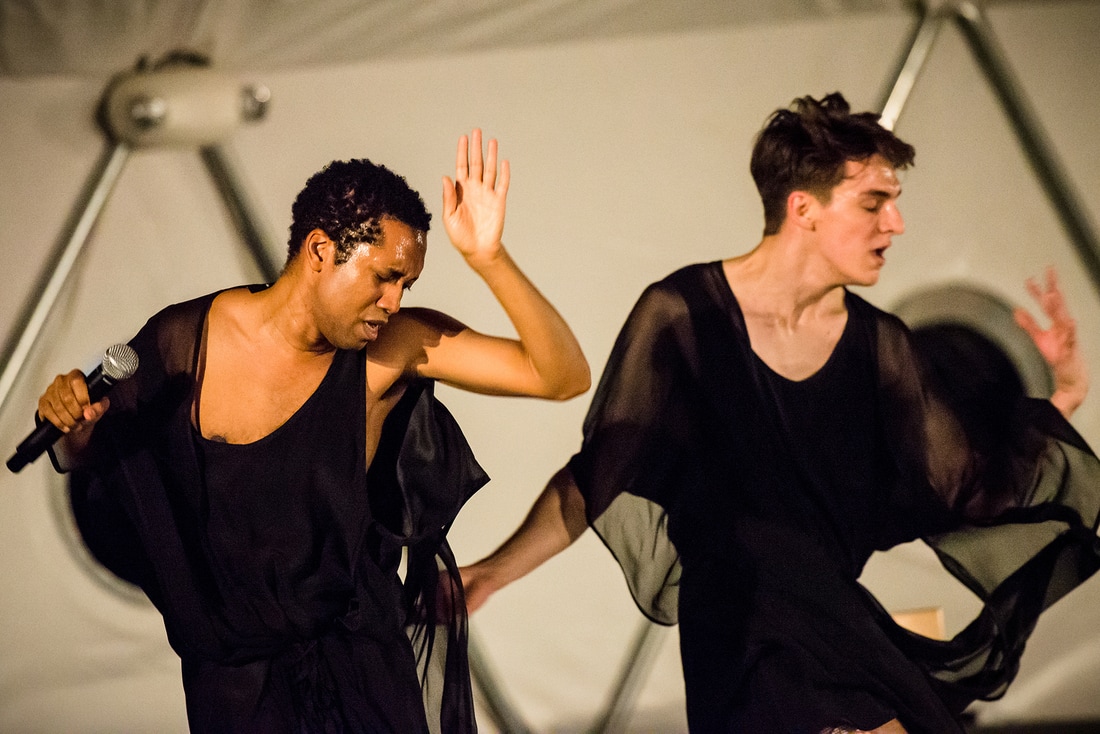
 Trajal Harrell & Thibault Lac in Judson Church is Ringing in Harlem (Made-to-Measure), photo by Ian Douglas 1. Judson Church is Ringing in Harlem (Made-to-Measure) / Twenty Looks or Paris is Burning at the Judson Church (M2M), Trajal Harrell + Thibault Lac + Ondrej Vidlar (Festival TransAmériques) American choreographer Trajal Harrell’s work has always been impressive if only for its sheer ambition (his Twenty Looks series currently comprises half a dozen shows), but Judson Church is Ringing in Harlem (Made-to-Measure) is his masterpiece. In the most primal way, he proves that art isn’t a caprice but that it is a matter of survival. Harrell and dancers Thibault Lac and Ondrej Vidlar manifest this need by embodying it to the fullest. The most essential show of this or any other year.
2. ENTRE & La Loba (Danse-Cité) & INDEEP, Aurélie Pedron Locally, it was the year of Aurélie Pedron. She kept presenting her resolutely intimate solo ENTRE, a piece for one spectator at a time who – eyes covered – experiences the dance by touching the performer’s body. In the spring, she offered a quiet yet surprisingly moving 10-hour performance in which ten blindfolded youths who struggled with addiction evolved in a closed room. In the fall, she made us discover new spaces by taking over Montreal’s old institute for the deaf and mute, filling its now vacant rooms with a dozen installations that ingeniously blurred the line between performance and the visual arts. Pedron has undeniably found her voice and is on a hot streak. 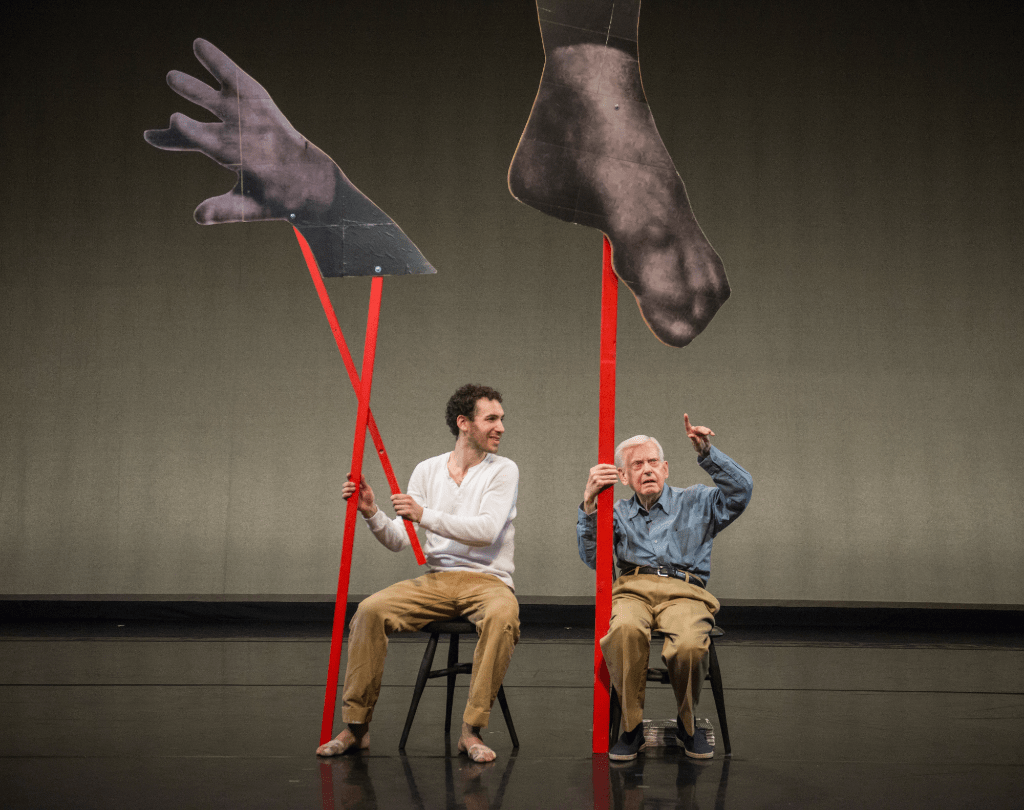 Pepper Fajans & David Vaughan in Co.Venture, photo by Stephanie Berger 3. Co.Venture, Brooklyn Touring Outfit (Wildside Festival) The most touching show I saw this year, a beautiful portrait of an intergenerational friendship and of the ways age restricts our movement and dance expands it. 4. Avant les gens mouraient (excerpt), Arthur Harel & (LA)HORDE (Marine Brutti, Jonathan Debrouwer, Céline Signoret) (Festival TransAmériques) wants&needs danse’s The Total Space Party allowed the students of L’École de danse contemporaine to revisit Avant les gens mouraient. It made me regret I hadn’t included it in my best of 2014 list, so I’m making up for it here. Maybe it gained in power by being performed in the middle of a crowd instead of on a stage. Either way, this exploration of Mainstream Hardcore remains the best theatrical transposition of a communal dance I’ve had the chance to see.  A Tribe Called Red, photo by Marc-André Mongrain 5. A Tribe Called Red @ Théâtre Corona (I Love Neon, evenko & Greenland Productions) I’ve been conscious of the genocide inflicted upon the First Nations for some time, but it hit me like never before at A Tribe Called Red’s show. I realized that, as a 35 year-old Canadian, it was the first time I witnessed First Nations’ (not so) traditional dances live. This makes A Tribe Called Red’s shows all the more important. 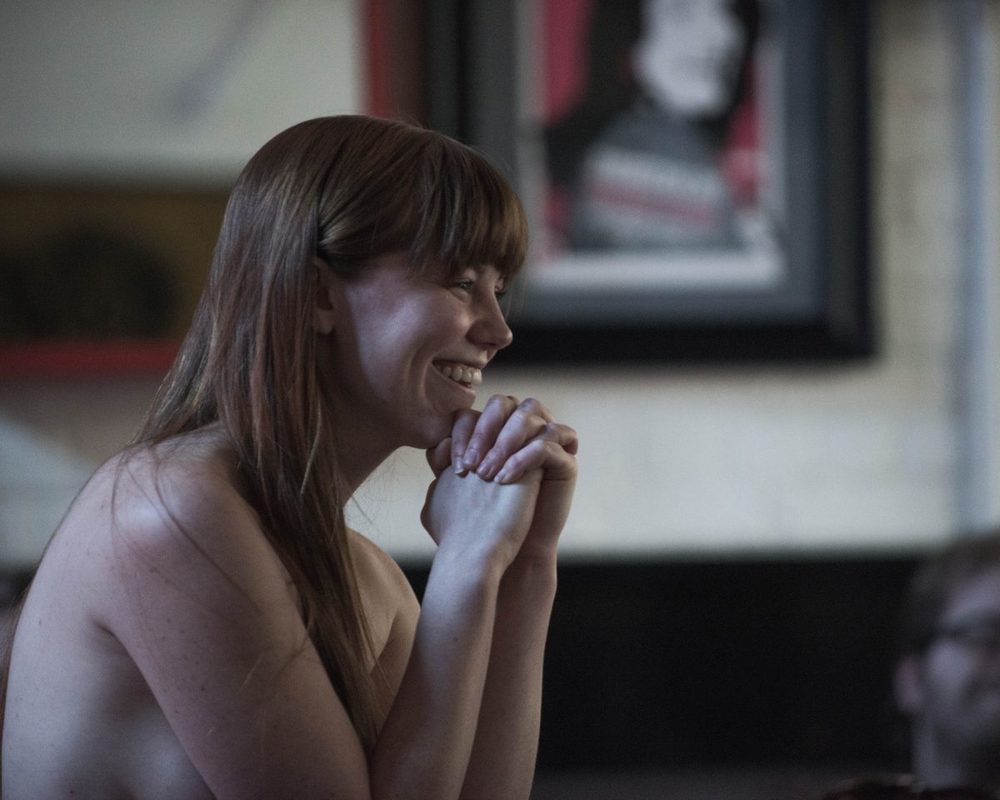 Thea Fitz-James in Naked Ladies 6. Naked Ladies, Thea Fitz-James (Festival St-Ambroise Fringe) Fitz-James gave an introductory lecture on naked ladies in art history while in the nude herself. Before doing so, she took the time to look each audience member in the eye. What followed was a clever, humorous, and touching interweaving of personal and art histories that exposed how nudity is used to conceal just as much as to reveal. 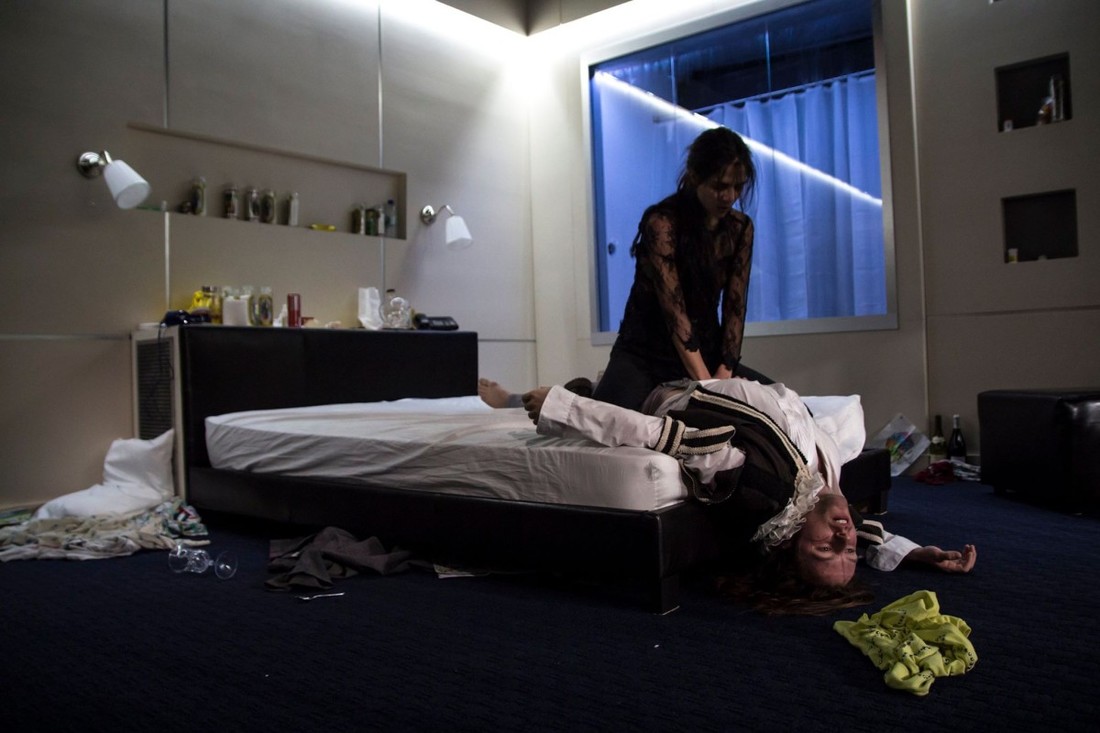 Clara Furey & Francis Ducharme in La très excellente et lamentable tragédie de Roméo et Juliette 7. Max-Otto Fauteux’s scenography for La très excellente et lamentable tragédie de Roméo et Juliette (Usine C)
Choreographer Catherine Gaudet and director Jérémie Niel stretched the short duo they had created for a hotel room in La 2e Porte à Gauche’s 2050 Mansfield – Rendez-vous à l’hôtel into a full-length show. What was most impressive was scenographer Max-Otto Fauteux going above and beyond by recreating the hotel room in which the piece originally took place, right down to the functioning shower. The surreal experience of sitting within these four hyper-realistic walls made the performance itself barely matter.
1 Comment
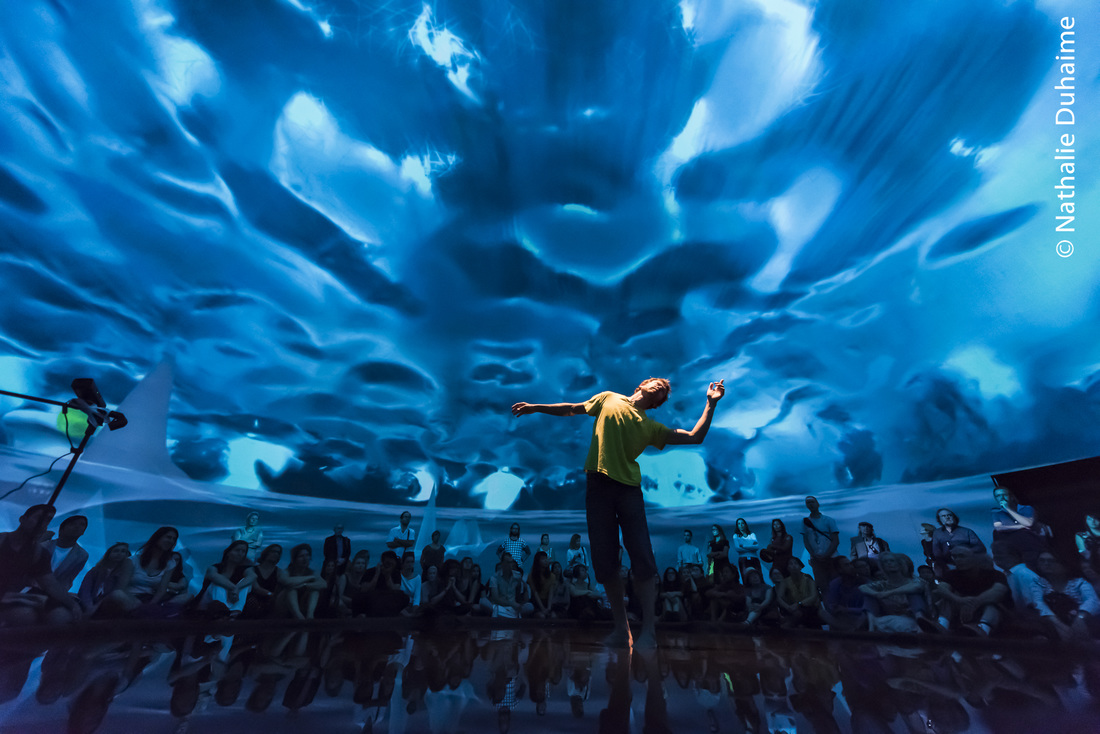 Peter Trosztmer in AQUA KHORIA, photo by Nathalie Duhaime Peter Trosztmer is both dancer and conductor in AQUA KHORIA, his collaboration with musician-digital artist Zack Zettle. Set within the dome of the SAT, Trosztmer evolves against a 360-degree animated projection that reacts to light and movement. In the middle of the floor: a small circular pond.
As we enter the room, we are surrounded by buoys, gently rocking their bells in the middle of the night. After the doors close behind the last spectator, Trosztmer whips the waters into a storm with his rain dance, looking like Mickey Mouse moving brooms about with his magic. The tumultuous waters swallow us into the calmness of its depth, pushes us back out, and ultimately pulls us back in. Follows an exploration of this underwater world, like an animated documentary without voice-over narration where experience is privileged over knowledge. A drop of water falls into the pond. (How nice it would have been had it been mic’ed.) As the pond is lit, we perceive its reflection as light play on the dome, a sky made of water. Sometimes I find myself believing that through art we’re looking to capture something of nature that we’ve lost: the chaos and the beauty. It would explain why there’s so much art in the city and so little in the country. Trosztmer approaches the water on all fours. When he finally dips his paws in, he stands but remains hunched over. We are simultaneously witnessing evolution and regression as a human being goes back to the water that we came from. The drop of water falls on him before turning into a stream in a quasi-Flashdance moment, as Trosztmer is now down to his underwear. We reach a cave of moving shadows as Trosztmer walks around the space holding a candle, and travel through a tunnel without taking a single step. Trosztmer then goes back to playing conductor with his movement, which espouses the shape of the dome: height and circumference, what we are guessing are the two main ways of controlling the sound. The music is provided by harp-like-sounding notes from a synthesizer backed by a chill beat, which ends up sounding like Muzak for a spa. We then find ourselves in what looks like lava inside a whale (or at least its bones), like Jonah. Soon, the whale is caught in a whirlpool and we are spat back out to the surface of the water, now calm again, as seagulls fly overhead. There is something of IMAX in the simplistic narrative followed here: exposition (calm waters), conflict (storm), journey (cave), climax (whirlpool), resolution (calm waters). Of course, we’re more interested in the 360-degree projection than we are in the dance. Who could possibly compete with technology? There could be a ten-inch screen broadcasting hockey behind a dancer and we’d find ourselves watching the game. Some transitions could have been smoother as the music, projection and performance keep changing at the same time, but ultimately AQUA KHORIA does play like an IMAX movie: pleasant while it lasts but otherwise unmemorable. October 11-21 www.tangente.qc.ca / www.danse-cite.org 514.844.2033 Tickets: 25$ 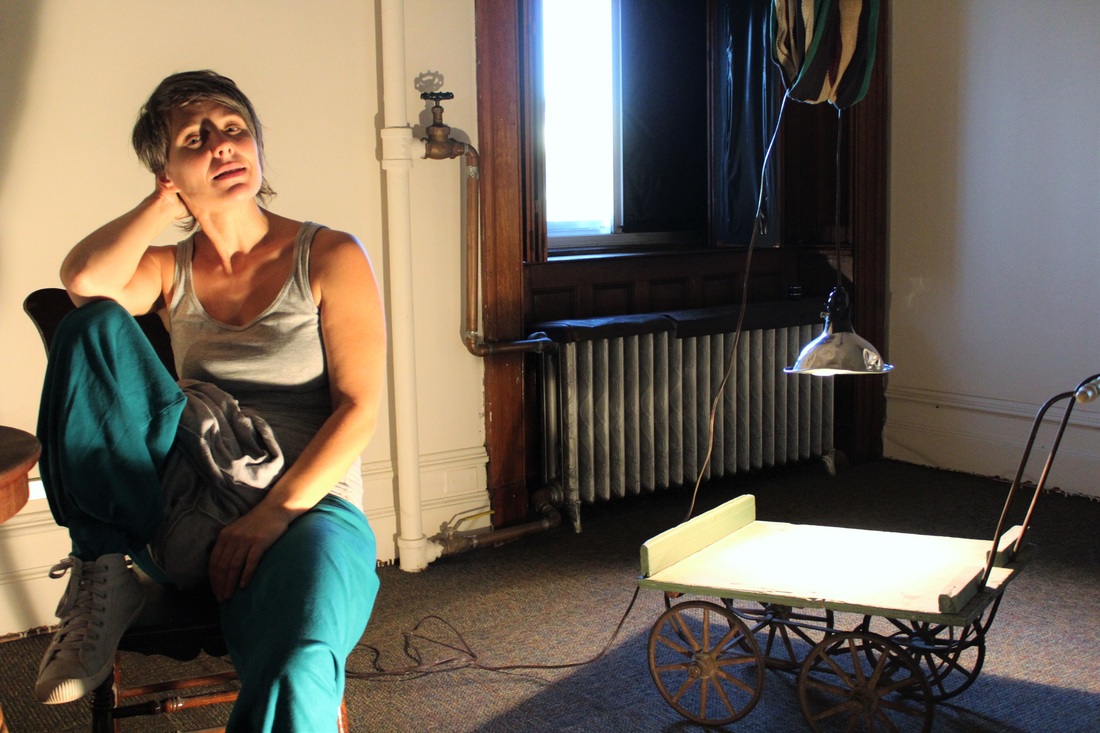 photo de Sylvain Verstricht En 2014, la chorégraphe Aurélie Pedron crée ENTRE, performance pour un spectateur à la fois. Les yeux bandés, celui-ci découvre l’œuvre au toucher, en demeurant en contact avec la danseuse. L’année suivante, elle remporte Le prix DÉCOUVERTE de la danse de Montréal. Au début de 2016, elle poursuit avec INDEEP, une performance de dix heures où des jeunes de la rue, les yeux bandés, évoluent dans un espace clos. Cette semaine, elle récidive avec LA LOBA, un déambulatoire composé de douze performances en simultané dans l’ancien institut des sourds et muets, jadis géré par des religieuses. SYLVAIN VERSTRICHT Comment as-tu découvert l’espace du 3700 Berri? AURÉLIE PEDRON Après mille téléphones. Des personnes qui m’ont envoyé à des personnes référentes qui m’ont envoyé à des personnes référentes… C’est quelqu’un qui travaillait pour l’Arrondissement du Plateau qui m’a dit « Tu devrais essayer de contacter l’institut des sourds et muets (qui est encore de l’autre côté de la bâtisse). Leur bâtisse est vide. » J’ai appelé là-bas. Ils m’ont donné le numéro de téléphone de la personne qui travaille au Gouvernement du Québec – parce que cette bâtisse appartient maintenant au gouvernement – puis il y a un employé de la location des espaces vacants et voilà! De tous les espaces vacants de Montréal – il y en a des millions – de tous ceux que j’ai réussi à contacter, c’est le seul que j’ai réussi à visiter et à louer. VERSTRICHT Qu’est-ce que tu cherchais en particulier? PEDRON Je cherchais un espace vide et suffisamment grand pour accueillir douze performances. VERSTRICHT Quel est ton rôle dans cette nouvelle création, LA LOBA? PEDRON Chorégraphe, parce que je travaille avec des corps, mais c’est très « installation-performance » tout ce qu’on a bâti. C’est performatif aussi parce que le temps va transformer l’état des interprètes et parce que je travaille avec d’autres matériaux, que je les mets en relation. Je suis vraiment entre les arts visuels et la danse. Les interprètes ont leur grande part de création aussi parce que je les fais beaucoup travailler sur de longues, longues improvisations. Elles me donnent du matériel et je construis à partir de ce matériel et de qui elles sont comme personnes. Ça, c’est important pour moi. VERSTRICHT Comment as-tu choisi ces interprètes? PEDRON Par instinct, beaucoup. Mais en fin de compte je réalise que j’ai rassemblé un bassin de personnes qui ont le même fond, une profondeur. VERSTRICHT Y a-t-il quelque chose qui relie toutes ces installations? PEDRON Oui, mais je n’ai pas envie de donner de thématiques. Je me bats comme un beau diable, parce que je trouve qu’il y a évidemment quelque chose qui a émergé de ce travail. Tu es au cœur d’une étoile. C’est douze performances. Ce n’est pas un spectacle avec un début, un milieu, une fin. Quand les spectateurs arrivent, ça a déjà commencé. Ça peut avoir commencé il y a mille ans, on n’en sait rien. Et, quand ils partent, peut-être que ça va continuer encore mille ans. VERSTRICHT Donc c’est un déambulatoire en continu où les spectateurs sont laissés à eux-mêmes? PEDRON Oui. Ils ne sont pas guidés. Il n’y a pas de chemins. Il y a juste quelques performances qui sont pour un spectateur à la fois, alors là il faut qu’ils s’inscrivent en arrivant. Ça se déroule sur trois heures. VERSTRICHT Qu’est-ce qui était là au début? Voulais-tu travailler quelque chose en particulier? PEDRON Il y a deux choses sur lesquelles je voulais travailler : le rapport au temps et à l’espace, pour l’interprète et pour le spectateur. Le rapport au temps, je l’ai déconstruit parce qu’il n’y a pas de linéarité et que le spectateur va savoir quand c’est bon pour lui, quand il en a assez d’une performance. S’il a envie de rester trois heures avec Rachel Harris, il peut rester trois heures avec Rachel. S’il veut rester une minute par performance et s’en aller au bout d’un quart d’heure, c’est parfait aussi. Je n’aime plus du tout le spectacle sur scène. Je ne suis plus bien avec ça. On a beau essayé de se décoincer des paramètres qui font que le théâtre est dans une salle, je n’y arrive pas. Milieu, début, fin : ça ne m’intéresse pas. Faire un show entre trente minutes et une heure, peut-être une heure trente si tu es super audacieux, je me sens coincée. J’avais envie de déconstruire ça et l’espace du public. Je trouve que d’avoir une centaine, deux cents, mille, deux milles personnes assises en face de toi… Le quatrième mur, il n’est pas entre l’espace du spectateur et des performeurs. Le mur, c’est les spectateurs. Ça, on ne peut pas le déconstruire. Ça fait qu’il faut exploser les spectateurs, d’où l’idée du déambulatoire. La performance dans la pièce où nous sommes présentement, ce sera juste pour quatre spectateurs à la fois. D’autres performances, un à un. On n’est pas engagé de la même manière comme spectateur. Quand on est dans un rapport de proximité et dans l’intimité du performeur, on devient super important et on voit notre potentiel à transformer l’œuvre. VERSTRICHT Tu t’es rendue compte de ça assez vite parce que tu n’as pas fait tant de pièces que ça dans des théâtres… PEDRON La dernière pièce que j’ai faite dans un théâtre était Corps caverneux et j’ai eu une insatisfaction avec cette pièce-là. J’avais touché une matière qui était intéressante pour moi, je n’étais pas nulle part, mais il manquait quelque chose. Et cette pièce-là, je l’ai écartée, je l’ai morcelée et j’en ai fait un parcours déambulatoire pour un spectateur à la fois dans un sous-sol au Festival de théâtre de rue de Lachine, puis là c’était magnifique. La pièce se tenait. C’était complet. C’est à partir de ce moment-là que j’ai réalisé qu’il faut que je déconstruise les formes. Je ne me sens pas à l’aise dans la forme traditionnelle. Je ne suis pas à mon meilleur et j’ai moins de plaisir à travailler comme ça. À partir de ce moment-là, j’ai fait ENTRE et j’ai fait d’autres performances avec des jeunes. J’ai beaucoup travaillé avec des jeunes marginaux ces dernières années et j’ai expérimenté un paquet d’affaires qui étaient vraiment satisfaisantes pour moi comme créatrice. INDEEP, qu’on a fait l’année dernière, était une performance de dix heures dans un lieu clos où les dix jeunes étaient à l’aveugle. C’était puissant. VERSTRICHT Il y a deux qualités principales qui m’apparaissent dans ton travail. Une qui y est de plus en plus, c’est la relation. Dans ENTRE, avec le spectateur, c’était flagrant. Quand tu parles d’intimité dans LA LOBA, est-ce que c’est une de tes préoccupations? PEDRON La qualité relationnelle, oui. Qu’on se dévoile mutuellement. Que l’interprète devienne interprète parce qu’il y a un spectateur et que le spectateur devienne spectateur parce qu’il y a un interprète. Ça, on le perd quand le public est une masse, parce que tu deviens anonyme. Tu es dans ton siège avec tous les autres spectateurs et tu attends que ça vienne jusqu’à toi. Tu deviens plus consommateur. Moi, je veux inverser les rôles. Je veux que tu ailles vers ce qui se passe. Parce que le spectateur est super important pour moi. C’est lui qui finit l’œuvre parce qu’il va s’en faire une image. Je ne veux rien lui imposer. J’aime qu’il aille puiser dans ses propres mémoires ce que ça évoque. VERSTRICHT L’autre qualité de ton travail qui reste d’une pièce à l’autre même si je les trouve très différentes, c’est quelque chose de politique. C’était peut-être plus évident dans tes premières pièces, mais je trouve que c’est encore présent dans INDEEP et même dans ENTRE, même si c’est plus subtil. Est-ce encore présent dans LA LOBA? PEDRON Ça ne se veut pas politique mais ce l’est. Je ne suis pas dans une revendication politique. ENTRE, c’est complètement politique, mais je m’en suis aperçue après. C’est anticapitaliste au boutte. C’est pour un spectateur à la fois. J’essaie de vendre ça aux diffuseurs : « –Ce n’est pas la quantité qui compte; c’est la qualité! » (rires) « –Oui, mais nous, on a des comptes à rendre au gouvernement. –Mais nous, on fait de l’art, pas de la politique! » (rires) Mais c’est non-rentable. Tu vas avoir douze spectateurs en trois heures et ça va te coûter le même montant que si tu en avais mille. VERSTRICHT Tout de même, ça a marché pour toi parce que tu l’as présenté beaucoup… PEDRON Oui, et je pense même qu’on va continuer. Ça donne de l’espoir! (rires) Mais ENTRE, c’est magique! Les gens qui vivent cette expérience, ils veulent la partager. Parfois, les diffuseurs ont de la misère, mais ils essaient au boutte. VERSTRICHT Après l’avoir fait? PEDRON Oui. VERSTRICHT Parce qu’ils deviennent convertis? PEDRON Oui. Ils veulent que les gens vivent ce qu’ils ont vécu. INDEEP est aussi super politique, parce que ce sont des corps marginalisés à la base et je les considère comme des êtres humains qui ont autant de valeur que Monsieur député de je-ne-sais-pas-quoi. Pour moi, ils ont peut-être encore plus de valeur parce qu’ils ont une richesse d’expérience de vie, puis je travaille avec eux et je les paye. Je le fais parce que ces jeunes-là m’intéressent, parce que j’ai à apprendre d’eux. Je ne le fais pas pour revendiquer « Il faut s’occuper de ces jeunes! » Ce n’est pas mon discours. VERSTRICHT J’ai vu passer sur Facebook que tes demandes de bourses avaient été rejetées par le Conseil des Arts une vingtaine de fois… PEDRON Vingt fois consécutives! En recherche et création, depuis que je dépose – c’est-à-dire depuis 2006 – j’ai eu une seule bourse et c’était une pour une vidéo-danse en 2007. Et j’ai déposé deux fois par année, chaque année, et je n’en ai jamais eue. J’en ai eue en production, j’en ai eue au CALQ, mais… Pour LA LOBA, je ne l’ai pas eue non plus, alors que j’avais déjà des images, que le projet était déjà avancé. Je n’ai même pas voulu appeler pour savoir pourquoi. Mais je pense que mon travail est trop « art performatif » pour la danse. Il faut que j’applique en arts multidisciplinaires maintenant. VERSTRICHT Avoir gagné Le prix DÉCOUVERTE de la danse de Montréal en 2015 ne t’a même pas aidé? PEDRON C’est ce que tout le monde me disait : « Maintenant, c’est le temps d’appliquer aux bourses parce que tu as eu une reconnaissance publique. » Bien, non! (rires) Je n’en revenais pas! Je n’en aurai jamais. Il faut que j’arrête d’appliquer en danse. VERSTRICHT C’est drôle parce que c’est quelque chose qui revient encore souvent… J’avais fait une entrevue avec Lara Kramer et elle m’avait dit qu’il y a des gens qui lui disent « Ce n’est pas de la danse… » PEDRON Il y a quelque chose de très conservateur en danse. Je suis certaine que quand les gens de danse vont venir voir LA LOBA, ils vont me dire que ce n’est pas de la danse. Ça ne bouge pas assez. Je ne suis pas quelqu’un de 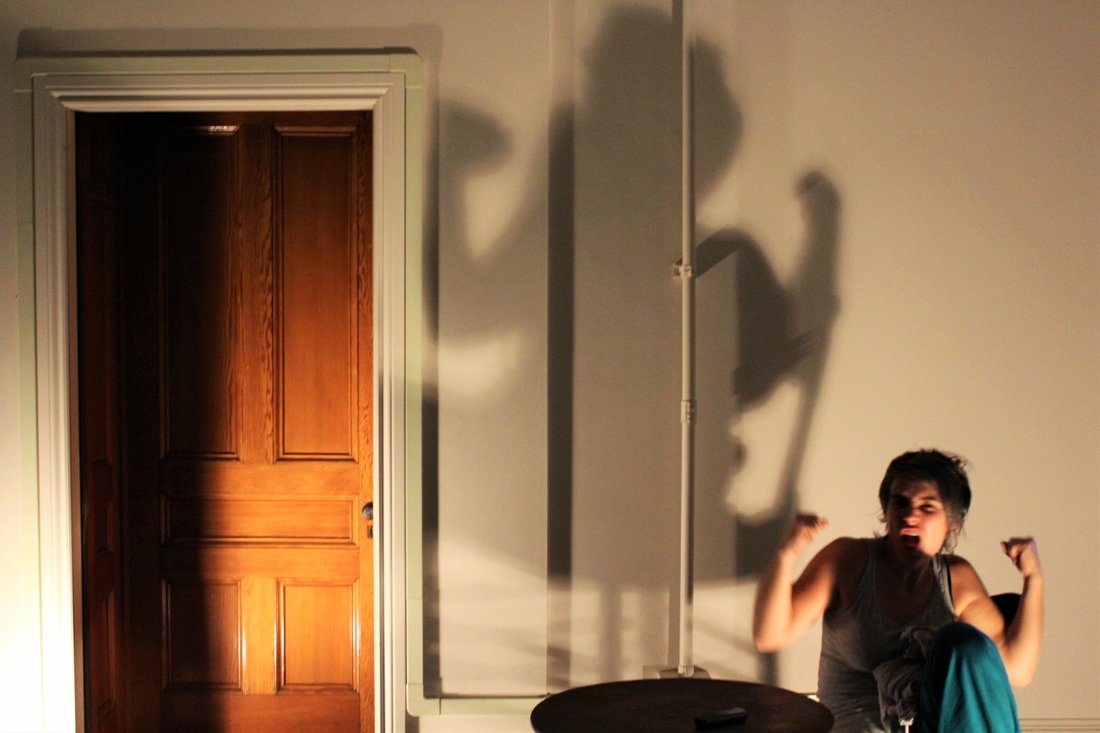 photo de Sylvain Verstricht de même. Ce n’est pas moi. Mais ce n’est pas pour autant que ce n’est pas de la danse. VERSTRICHT Est-ce que c’est une préoccupation que tu as ou tu fais ce que tu veux? PEDRON Je fais ce que j’ai à faire. S’il y en a qui aiment, c’est tant mieux. Je le souhaite. S’il y en a qui n’aiment pas, ils n’aiment pas. Je ne suis pas dans la séduction de mon public. Avec ENTRE, c’est autre chose parce qu’on est dans une telle intimité que mon public devient l’œuvre, mais je ne suis pas dans la séduction. Je suis dans l’écoute. Je deviens le reflet de qui tu es et tu deviens le reflet de qui je suis parce que tu me sens et je te guide. C’est un jeu de miroir. C’est ça qui fait la profondeur de ENTRE. C’est une mise en abyme. Ça va loin. Ça me dépasse. Ce n’est plus moi. Je ne suis plus maître d’œuvre. VERSTRICHT Comment l’as-tu créé? PEDRON Au début, j’avais un truc avec de la technologie bien compliquée… Je n’ai jamais eu de bourse. Je me suis retrouvée avec une résidence mais j’avais zéro argent. Je savais que je voulais travailler sur la rencontre et l’intimité, puis après j’ai pensé « Si je mettais les gens de le noir… » C’est parti de là, parce que je n’avais pas d’argent, que j’ai dû faire sans rien. Puis, après coup, j’ai eu l’argent et j’ai pu monter toute la structure qui va avec. L’idée de mettre le spectateur à l’aveugle est venue parce que j’avais rencontré un aveugle six mois avant et j’avais été fascinée par l’écoute de son corps. Parce qu’il ne voyait pas, son corps est devenu très savant et ça m’a inspiré. Il m’avait demandé « Tu fais quoi comme métier? » Je lui avais dit « –Chorégraphe. –Qu’est-ce que c’est ça, ‘chorégraphe’? » Je me suis posée la question « Comment pourrais-je partager mon métier avec quelqu’un comme ça? » Ça a été mon déclic pour ENTRE. Quand je suis entrée en résidence, je n’avais pas d’argent, pas de matériel. J’ai fait « C’est ça que je vais faire! Je vais mettre le spectateur à l’aveugle et je vais lui faire vivre le mouvement autrement, comme il ne l’a jamais vu puisqu’il ne le voit pas. » VERSTRICHT Est-ce que cette personne-là a eu la chance de faire ENTRE? PEDRON Non. Il n’était plus là. VERSTRICHT Je ne sais pas si tu as lu le livre dans lequel on pouvait écrire à la sortie de INDEEP… J’ai resté environ une heure et je me sentais très bien. À un moment donné, il y avait un garçon qui était étendu par terre et je regardais sa main et, je ne sais pas pourquoi-- PEDRON Ah, c’est toi… VERSTRICHT --j’ai presque pleuré. PEDRON Quand j’ai lu ça, j’ai été touchée parce que j’ai eu la même sensation que toi : d’être dans une telle proximité, mais avec un inconnu qui est tellement vulnérable et tellement proche, puis que lui ne sait pas que tu es là, ça fait qu’il est abandonné… VERSTRICHT Il y avait quelque chose du sommeil, de voir quelqu’un dormir et ils n’ont aucun mur d’érigé pour se protéger. Ils sont vulnérables. Je suis parti peu de temps après avoir eu ce moment-là, parce que c’est un spectacle anti-dramatique et tout à coup, à la cinquantième minute, j’ai eu ce moment-là. Pour moi, c’était le point culminant, donc je suis parti. PEDRON Quand je dis que le spectateur va construire son propre temps, c’est exactement ça. Tu as pris la responsabilité de dire « Moi, je finis là-dessus. » Tu es devenu le créateur de ton œuvre à toi. Et je trouve ça très important. VERSTRICHT Ça fait combien de temps que tu travailles sur LA LOBA? PEDRON Deux ans et demi. VERSTRICHT Est-ce qu’entrer dans l’espace il y a une semaine à peine a changé quelque chose? PEDRON Ça connote. On ne peut pas y échapper. C’est puissant, un lieu. Ce lieu-là raconte déjà quelque chose sans qu’on n’ait rien fait. En même temps, je choisis d’aller dans des lieux qui ont une certaine couleur. Ce lieu a un certain vécu. C’est rare des bâtisses qui sont aussi vieilles à Montréal. Le poids de l’histoire, c’est important. Si je loue un lieu vacant, c’est aussi pour ça, donc j’accepte qu’il colore le travail. VERSTRICHT C’est quoi ton sentiment par rapport au lieu? Est-ce que tu es satisfaite de ce que tu as trouvé? PEDRON Je suis très satisfaite. Je trouve ça magnifique. C’était l’institut pour les sourds et muets du Québec, tenu par les sœurs. Il n’y a plus les sœurs, mais il y a un institut pour les sourds et muets qui est dans la bâtisse d’à côté. Ici, avant, c’était des locaux administratifs du Gouvernement du Québec. VERSTRICHT Et maintenant c’est vacant. PEDRON Et c’est chauffé l’hiver. À tes frais. C’est fou quand même, quand tu y penses. C’est quatre immenses étages. Tu pourrais loger la moitié de tous les sans-abris de Montréal. 20-25 septembre www.danse-cite.org 514.982.3386 Tarif unique : 25$ 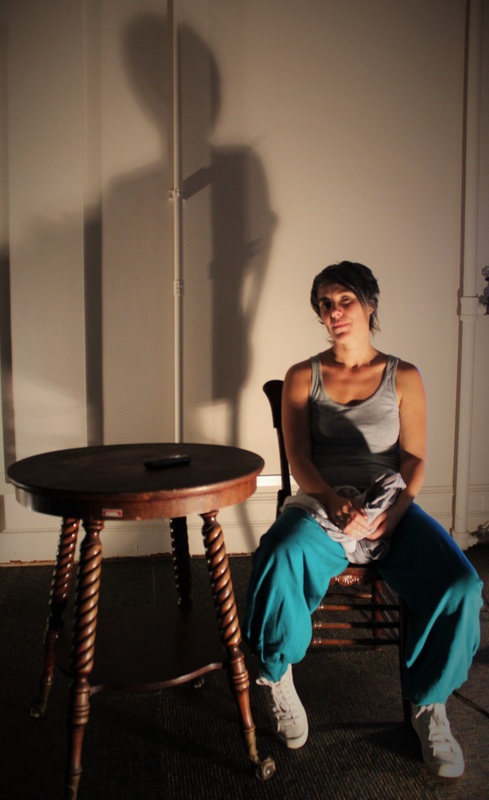 photo de Sylvain Verstricht  Diane Carrière in Et après... le silence, photo by Danielle Bouchard Going to Festival Quartiers Danses’s Programme triple at Cinquième Salle on Saturday night was like traveling to the past without experiencing nostalgia. The evening opened with Diane Carrière’s reconstruction of ABREACTION (1974), titled Et après… le silence for this version. What first strikes us is how far music for dance has come over the past forty years. Here it almost sounds parodic in its likeness to the cheaply dramatic scores for low-budget straight-to-video productions. It is even more dated than the affected modern movement. Dancer Sébastien Provencher, always reliable, uses all of his length as he extends his arms as far as they will go. Nothing to do about it though: isolated screams are always funny, no matter what they’re supposed to communicate. Carrière joins Provencher for the second half of the piece. How satisfying it is to watch older people dance. It is unfortunate that Carrière was otherwise so precious with her material, refusing to shake off the music or the video footage that anchored Et après as a dusty historical document instead of truly resurrecting it to make it relevant for a contemporary audience.  Jacinte Giroux in Mutable Tongues, photo by Dave Gaubiac Followed Victoria choreographer Jo Leslie with her duet Mutable Tongues. We’d already had the chance to see Leslie’s work at Tangente in 2011 with Affair of the Heart, an understated solo for Jacinte Giroux, a Montreal dancer whose speech and movement have been transformed by a stroke. Here again we found Giroux, this time accompanied by Louise Moyles, a dancer and storyteller from Newfoundland. Moyles walks into the room alternately speaking English and French. This self-translation makes everything she says sound phony. Giroux is lying face down on the stage, just outside the spotlight. She tells Moyles she’s had a stroke, but Moyles doesn’t listen, tells her to “get up” then to “lie down.” She is verbally abusive in a way that ableist culture is always abusive, even when it doesn’t use words, when instead of saying “get up” it just puts a staircase. We think of how choreographer Maïgwenn Desbois had subverted this idea by letting her neurodiverse dancers briefly choreograph her in Six pieds sur terre. With its burnt orange dresses, black tights, and heavy reliance on theatre, Mutable Tongues also feels a bit dated, not to mention that it is even more didactic than Carrière’s piece (which used voice-over to bring up such topics as hand-to-hand combat and PTSD). It reminded me of Chanti Wadge’s The Perfect Human (No. 2), which found its inspiration in dancers answering the question “Why do you move?” A young woman had walked to the front of the stage and screamed “I move because I hate talking!” I would turn it around and say that I go see dance because I love when people shut the fuck up. That’s certainly when Mutable Tongues is at its best.  Beaux moments, photo by Howard Richard The evening concluded with Howard Richard’s Beaux moments, a piece for four women that was the most contemporary thing we got to see, though even then it was more akin to the beginnings of contemporary dance. There were moments that recalled Ginette Laurin’s work: the legs that were lifted while turning out at a 45-degree angle before the heels of the shoes thumped back down against the floor; the sideways lifts where a woman would throw herself under her partner’s arms so that she could lend on their thighs. However, Richard’s movement was less verbose and neurotic than Laurin’s. In the duets, the women also looked as if they were in each other’s way rather than working together. But even the electronic music and the costumes (black sleeveless dressed with red short-heeled shoes) had something of O Vertigo about them. There was also a solo set to Cat Power’s “The Greatest” that failed to fit with the rest of the piece as it flirted with the contemporary in a So You Think You Can Dance way.
The most positive aspect of the triple bill was the chance to see middle-aged women dance, including Estelle Clareton. But, if we were to base an opinion on this evening alone, we would be inclined to say that we’d rather watch older people dance rather than choreograph. Maybe La 2e Porte à Gauche had the right idea with Pluton. www.quartiersdanses.com September 6-17 514.842.2112 / 1.866.842.2112 Tickets: 25$ / Students or 30 years old and under: 20$  Pluton – acte 2, photo de Claudia Chan Tak De Pluton – acte 1, je garde un souvenir d’un spectacle tout en douceur. Ce que La 2e Porte à Gauche nous réserve pour ce deuxième mariage de jeunes chorégraphes avec des interprètes plus âgés s’avère toutefois plus corrosif.
Il est étonnant que la pièce de Frédérick Gravel soit celle qui s’aligne le plus avec le premier acte, probablement dû au fait que Paul-André Fortier la danse. Les genoux et les coudes fléchis, il se déplace du côté cour au côté jardin en pivotant, les semelles de ses espadrilles rouges glissant contre le sol. Même s’il épouse le corps recroquevillé de Gravel, ses mouvements sont plus soignés et fluides. Je me rends compte que, jusqu’à maintenant, je ne l’ai vu que dans des contextes où il dansait ses propres chorégraphies, de sorte que j’oublie parfois que c’est Fortier que je regarde parce que je ne reconnais pas sa posture habituelle. Je ne reconnais pas tout à fait la chorégraphie de Gravel non plus, qui se fait ici beaucoup plus doux et subtil. C’est la beauté de ce projet. Catherine Gaudet s’était démarquée avec son solo créé pour Louise Bédard pour acte 1. Il n’est donc pas surprenant de le retrouver ici. Gaudet continue d’y explorer l’un de ses thèmes fétiches, soit la duplicité de l’humain. Bédard est d’abord dos au public en arrière scène, ses expirations flirtant avec les grognements, invoquant simultanément les bébés naissants de Je suis un autre (2012) et les monstres d’Au sein des plus raides vertus (2014). Elle est une bête qu’on cache loin des regards. Ses doigts arthritiques ressemblent plus à des griffes qu’à une main. Lorsqu’elle nous fait face, un sourire se plaque sur son visage tremblotant. Elle veut paraître en contrôle, mais la surface ne peut que craquer, comme toujours chez Gaudet. Ce n’est pas la part animale ou monstrueuse de l’humain qui transparaît ici, mais les troubles de santé physique et mentale. On peut y voir la maladie de Parkinson ou celle d’Alzheimer. C’est à mon humble avis ce que Gaudet a fait de mieux. Après l’entracte, les spectateurs se retrouvent des deux côtés de la scène pour la pièce de Mélanie Demers, un duo pour Marc Boivin et Linda Rabin. Le musicien Tomas Furey s’avance à un micro sur scène, y va d’un « 3, 4 » mais ne chante pas. C’est Boivin et Rabin qui alterne respectivement « New York, New York » et « Let Me Entertain You », rivalisant d’exhibitionnisme performatif. Ils en sont agressants. Comparativement, Furey nous charme avec son silence, nous offrant une sortie de secours essentielle. C’est la pièce la moins séductrice, la plus abrasive de Demers à ce jour. On pourrait dire la même chose de celle de Katie Ward, un solo pour Peter James. Des chaises sont éparpillées sur la scène et les spectateurs sont invités à y prendre place. Soir de première, c’est une vingtaine d’adolescentes qui se sont prêtées au jeu, créant une atmosphère particulière. Pour ceux d’entre nous qui ont été témoins des explosions verbalement violentes de James dans des pièces comme Mygale (2012) de Nicolas Cantin, nous devons nous retenir pour ne pas crier « Ne le laissez pas s’approcher de ces jeunes filles! » Heureusement, nous retrouvons plus le ludisme de Ward marié au minimalisme de James, déjà aperçu dans sa collaboration avec Cantin pour Philippines (2015). En fait, cet opus ressemble plus à du Cantin qu’à du Ward. Aucune illusion ici; James joue avec le théâtre, littéralement, c’est-à-dire avec la salle de spectacle elle-même. Les lumières éclairent tout l’espace. Il secoue la rampe des escaliers, il modifie la lumière à la console d’éclairage, il manipule les rideaux en nous disant, « Ça, c’est vrai. » Il lance une balle contre le mur juste pour nous rappeler que le mur est là, pour que l’espace s’impose plutôt que de s’effacer sous l’effet de la performance. C’est dans ses interactions avec le public qu’on approche de la magie, comme lorsqu’il prétend dévisser un tube invisible du ventre d’une des adolescentes pour ensuite le déposer sur une chaise. « Ce n’est pas nous qui créons la magie, » semble-t-il vouloir dire. « C’est vous, spectateurs. » 28-30 mai à 19h www.fta.ca 514.844.3822 Billets : 40$ / 30 ans et moins : 34$ 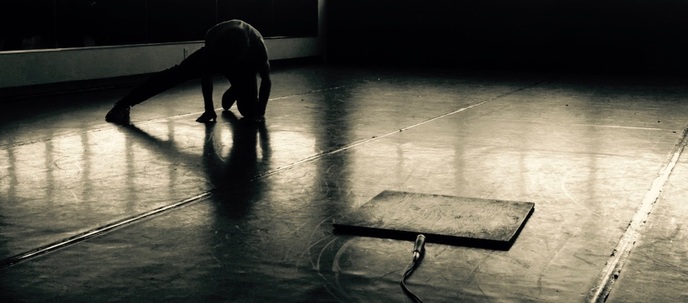 (re)tracer, photo d'Antoine Turmine Lors d’un récent passage à la Passerelle de l’UQAM, j’ai remarqué Antoine Turmine dans Suicide intellectuel, un solo pour lequel il passait la majorité de la pièce à écrire sur le plancher à la craie dans une obscurité qui rendait son écriture pratiquement illisible. Après avoir dansé pour bon nombre de chorégraphes au cours des différentes éditions de la Biennale de Gigue Contemporaine (BIGICO) – dont Lük Fleury, Nancy Gloutnez et Jean-Philippe Lortie – Turmine présentera pour la première fois une pièce de gigue contemporaine de son propre cru pour la toute première édition du OFF BIGICO. Je me suis entretenu avec lui moins de deux semaines avant la première.
Quel est ton parcours? Je danse depuis que j’ai dix ans. J’ai commencé dans un ensemble folklorique qui s’appelle Mackinaw, à Drummondville. Des danses du monde… Si tu montes les échelons, tu travailles la gigue en particulier. J’ai dansé là une dizaine d’années, puis en 2010-2011, je me suis intégré à la compagnie Zogma à Montréal. À partir de là, je me suis ouvert à la danse et à la gigue contemporaines. J’ai fait un baccalauréat en danse à l’UQAM et maintenant je fais la maîtrise. Qu’est-ce que tu retires de la gigue que tu ne trouves pas en danse contemporaine? Je vais être bien franc : rien. C’est plus un cadre de travail que je m’impose, versus n’importe quel artiste peut faire n’importe quoi en danse contemporaine. C’est ce qui est le fun aussi. En gigue contemporaine, c’est de dire « Voyons ce qu’on peut faire à partir du matériau qu’est la gigue. » Comment as-tu emmené la gigue dans le contemporain pour le OFF BIGICO? Qu’est-ce que tu travailles? Ayant souvent été interprète, j’ai toujours été intrigué par le fait qu’on demande aux artistes d’être précis au niveau sonore en gigue traditionnelle. On veut une clarté dans le son. Je me suis toujours posé la question « Pourquoi c’est si important? C’est quoi le défaut de faire des bruits parasites? » [Avec le OFF BIGICO,] j’ai l’opportunité de faire un laboratoire, de me péter la gueule et que ce ne soit pas grave. C’est juste de proposer quelque chose; on se fout du résultat. Donc je me suis dit, « Je vais explorer le bruit; voir si on peut organiser ce qui est parasite normalement de manière à ce que ça fasse une certaine musicalité et un rythme quelconque, et que ça devienne intéressant pour le spectateur. » Il y a toujours deux affaires qui m’intéressent, et c’est pour ça que je m’intéresse à la danse contemporaine : la dynamique du mouvement et le son qui est produit. Le bruit est quelque chose qu’on met de côté alors que ça nous ouvrirait peut-être un pan de la gigue qu’on n’explore jamais parce qu’on ne se le permet pas comme ce n’est pas inscrit dans notre patrimoine de gigueur. Est-ce qu’il y a des bruits en particulier qui ressortent? J’aime bien tout ce qui est un genre de frotté, de glissé du pied au sol, qui permet beaucoup plus de subtilité au niveau des nuances sonores. Si je fais un mouvement qui est dynamique, je peux aller dans quelque chose qui est impulsif, continu… Je peux faire la même chose avec un glissé, un frottement. Je peux rajouter une variante à ce frottement-là, ce qui est beaucoup plus difficile à faire sur un son qui est précis. Avec un son qui est précis au sol, tu as un son qui va rester (aigu) et un son qui va s’ouvrir (sourd). Quand tu le fais glisser, tu as une emprise sur la temporalité de ce son-là. Ça permet plus de possibilités. C’est cliché, mais ça me fait penser à John Cage, 4’33” en particulier. Tant qu’à être dans ce type d’influence, je te dirais plus que c’est Pierre Schaeffer. Il est beaucoup plus dans l’objet sonore. Il donne une intention au son. C’est ça qui fait qu’on le hiérarchise, qu’on lui donne une importance dans la composition musicale. Donc c’est un peu de la musique concrète pour gigueur que tu fais. De la manière dont tu parles, ta préoccupation est plus musicale que visuelle… Ça peut sembler comme ça, mais ce n’est pas le cas. Je travaille seul – c’est un solo que je fais – et je me filme lors des répétitions pour avoir une idée d’à quoi ça ressemble et de comment ça sonne aussi. En regardant ce que ça fait, je me rends compte qu’on s’attarde beaucoup plus au mouvement des pieds que si je faisais une gigue traditionnelle, que si je faisais des sons clairs et que c’était des séquences. (En gigue, c’est souvent des séquences qu’on fait.) Là, on dirait qu’il y a un travail différent du corps. Juste pour garder l’équilibre pour produire ces sons-là, ça demande une organisation spéciale du corps et on voit bien les dynamiques des jambes. Je trouve ça intéressant au niveau du mouvement aussi. Ce n’est pas juste sonore. Est-ce que la recherche que tu fais à l’UQAM influence ce que tu fais en gigue contemporaine? Un peu, parce que ça m’a intéressé le bruit que ça faisait quand j’écrivais avec la craie [dans Suicide intellectuel]. Mais c’est la seule chose qui se recoupe. Je dois t’avouer que j’ai vraiment deux parties de moi qui travaillent toujours, qui se côtoient plus qu’ils ne se fusionnent. D’un côté, j’ai ma pratique de la gigue; de l’autre, j’ai ma pratique en danse contemporaine. OFF BIGICO 8-10 avril www.auxecuries.com 514.328.7437 Billets : 27$ / Étudiant : 19$
MARIE CHOUINARD Il le faut. C’est notre responsabilité de faire vivre nos spectacles plus longtemps. On est obligé. Si on veut vraiment vivre ce bonheur-là de danser nos spectacles plus longtemps, il faut les amener partout dans le monde. Juste jouer dans notre ville natale, ce n’est pas assez. VERSTRICHT Étant donné que vous avez ce privilège, comment vous sentez-vous par rapport à la reprise de Prélude à l’après-midi d’un faune et de Le Sacre du printemps plus de vingt ans plus tard? CHOUINARD On ne les reprend pas; on ne les a jamais lâchés! (rires) Notre Sacre du printemps, ça fait 23 ans qu’on le fait à chaque année. L’après-midi d’un faune aussi. Habituellement, les œuvres que je crée ont la chance de vivre très longtemps. VERSTRICHT Pour vous, c’est une bonne chose, vous n’êtes pas tannée du tout… CHOUINARD Bien non! C’est comme si on disait « La Joconde est-elle tannée de sourire dans son cadre? » (rires) C’est le contraire! Les danseurs aiment danser un grand répertoire de pièces. En ce moment, les danseurs dans ma compagnie sont en Europe et ils font sept chorégraphies différentes pendant la tournée. Ils sont contents. Ils aiment ça. Puis dans une autre tournée, ça va être encore d’autres pièces. C’est le fun. C’est hot de pouvoir danser plein de pièces différentes parce que c’est un répertoire qui a toutes sortes de facettes, d’approches : différentes pièces, différents rôles que les danseurs ont… C’est vraiment excitant pour eux. VERSTRICHT Est-ce qu’il y a une concordance pour vous entre ces pièces qui perdurent et celles que vous voudriez qui perdurent? Est-ce qu’on réussit à prédire celles qui– CHOUINARD Non. C’est bien mystérieux. On ne peut jamais savoir. C’est impossible. À chaque fois que je fais une nouvelle pièce, je me dis, « Peut-être que celle-là ne tournera pas, que personne n’en voudra. Peut-être que moi, je vais l’adorer, mais personne ne va l’aimer. » VERSTRICHT Est-ce qu’il y en a une que vous aimeriez voir revivre? CHOUINARD Oui. J’ai une pièce qui s’appelle LE NOMBRE D’OR… VERSTRICHT J’adore LE NOMBRE D’OR. CHOUINARD Moi aussi, mais elle est compliquée au niveau technique parce qu’il y a un corridor qui s’avance dans le public et je veux du public sur le stage, puis les gens qui l’achètent disent, « Mais là, on ne peut pas vendre nos billets dans la salle… » C’est devenu tellement compliqué pour les producteurs qu’ils ne l’ont presque pas achetée. Au niveau de la scénographie, j’ai fait un design qui n’est pas facile à tourner. C’est plate, hein? (rires) VERSTRICHT Oui, parce que ça mérite vraiment d’être vu. CHOUINARD J’adore cette pièce-là et les danseurs aiment la danser aussi. C’est drôle que vous me parliez de ça parce que je pensais à ça il y a une semaine ou deux, je me disais, « Qu’est-ce qu’on pourrait faire? Est-ce que j’enlèverais le corridor dans le public et le public de sur la scène? » Puis je me suis dit, « Bien non! Ça fait partie de sa beauté toute cette scénographie-là que j’ai faite. » Ça fait que c’est plate. Je ne sais pas ce qu’on va faire. J’espère qu’un jour elle va reprendre la route. VERSTRICHT Étant donné que vos pièces jouent pendant aussi longtemps, est-ce que vous arrivez à dire de façon générale à partir de quel moment une œuvre devient fixe? CHOUINARD C’est pas mal après 2-3 représentations. C’est sûr qu’après le soir de la première, je vais changer des petites choses. Le lendemain de la première ou de la deuxième, je peux couper trois minutes. Je peux faire des gros changements. Les danseurs le savent. Après ça, c’est des détails. C’est sûr que moi, je les trouve importants, mais je ne suis pas sûre que le monde les remarque tant que ça. Ce que j’ai la chance de faire aussi – je mets ça dans mon budget de création – c’est qu’avant de faire ma première mondiale, je m’organise pour faire le spectacle dans un théâtre avec un petit public de rien du tout. Je le fais comme en secret, donc ça me permet de le tester. Par exemple, la première fois que j’ai fait Gymnopédies, c’était en cachette à Miami. Je ne l’ai pas appelé Gymnopédies, je lui ai donné un titre barbare, mais je l’ai testé. (rires) J’ai profité du fait qu’on était là pour dire, « Là, on va faire une pièce un petit peu undercover… » VERSTRICHT Les costumes sont tellement une partie essentielle de vos spectacles, ils colorent tellement la chorégraphie que j’ai l’impression qu’il faudrait qu’ils arrivent assez tôt dans le processus… CHOUINARD Non, ils arrivent à la fin complètement; sauf pour L’après-midi d’un faune parce que je savais dès le début, quand je l’ai créé pour moi, que j’aurais des cornes sur la tête. VERSTRICHT Est-ce que vous vous patentiez quelque chose? Est-ce que vous jouiez avec une sorte de pré-corne? CHOUINARD Oui, je me mettais ça sur la tête, et c’est justement en jouant avec qu’un moment donné j’avais une corne dans mes mains et je me suis rendue compte, « Oh, my God… Si je la mets sur mon pubis, ça fait un phallus. » C’est arrivé de même! Ce n’était pas une idée préconçue. 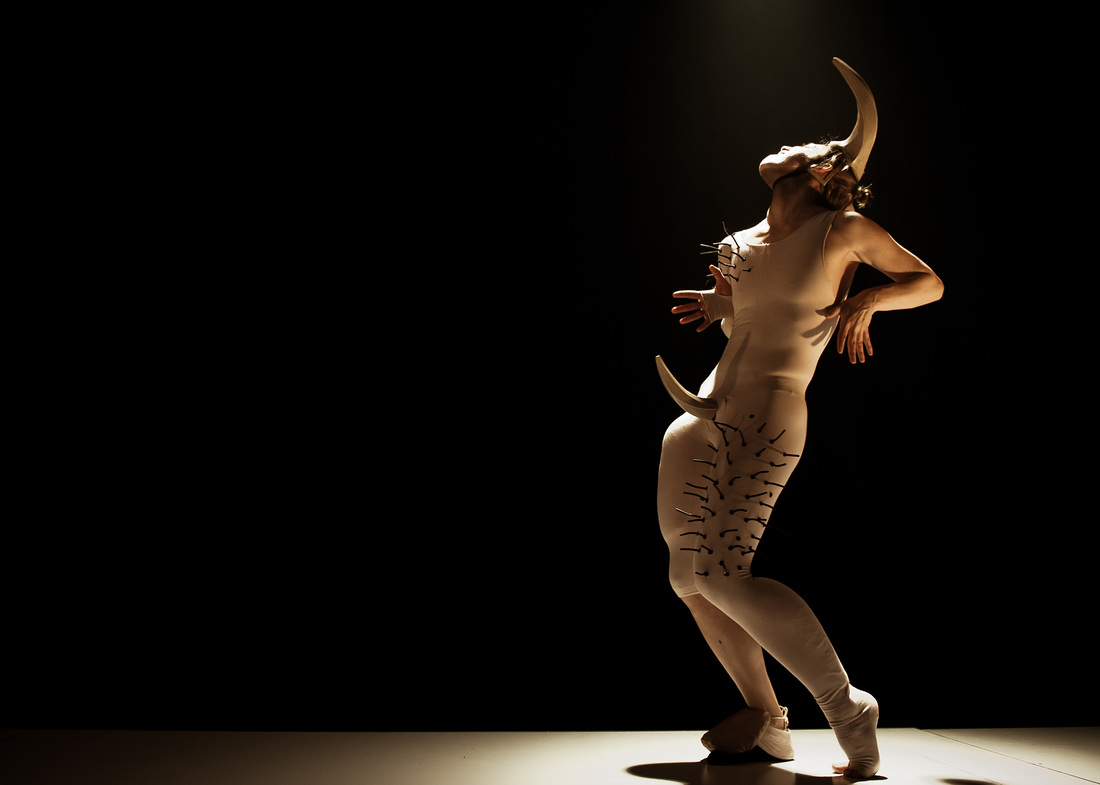 Prélude à l'après-midi d'un faune, photo de Sylvie-Ann Paré VERSTRICHT Quand on est Marie Chouinard, est-ce qu’il y a encore certains fantasmes de danse qu’on n’a pas réalisés?
CHOUINARD Je n’ai jamais eu de fantasmes. Je ne travaille pas par fantasme. Je travaille par urgence de créer. J’ai des intuitions très fortes de création, puis je crée. Je crée en masse… Je suis en train de créer une pièce pour le ballet de Martha Graham à New York. Je suis aussi en train de peaufiner un duo que j’ai fait pour Les 7 doigts de la main. Je suis tout le temps en train de créer. C’est ça que j’aime faire. VERSTRICHT Si vous êtes dans l’urgence, est-ce que ça veut dire que vous n’avez aucune peur de– CHOUINARD Non, je n’ai pas peur. C’est la joie! (rires) J’ai la création solaire, comme on dit. Je ne suis pas du tout occidentale; je ne vais pas me couper une oreille pour créer. (Je pense à Van Gogh…) Je ne suis pas dans l’angoisse quand je crée. Je suis dans l’action, le bonheur de créer. Je ne dis pas que des fois je ne me retrouve pas peinturée dans un coin à me demander « Qu’est-ce que je fais? Où suis-je rendue? » Mais je sais que, quand tu es dans un coin, il faut que tu recules un peu, puis là tu commences à voir, « Ah… Il y a une porte par là… » VERSTRICHT Quel est votre rapport à la critique? CHOUINARD Je ne les lis pas tellement. VERSTRICHT Pour quelle raison? CHOUINARD Je vais vous dire une réponse que vous allez trouver bizarre… J’ai rarement appris quelque chose. VERSTRICHT Je ne trouve pas ça bizarre du tout. Je trouve ça très intéressant, en fait. CHOUINARD Je préfère avoir une conversation avec un spectateur sur son expérience. Il faut quand même que je dise que des fois des critiques super élogieuses viennent à mes oreilles et ça me fait plaisir. C’est comme quand tes danseurs se font applaudir, quinze rappels… C’est sûr que ça fait plaisir. C’est comme recevoir de l’amour. VERSTRICHT Est-ce votre moment préféré? CHOUINARD Mon moment préféré, c’est de voir mes danseurs sur scène. Je me dis, « Ah… Ils sont tellement bons! » (rires) Je les trouve merveilleux. VERSTRICHT De quoi la danse a-t-elle besoin aujourd’hui? CHOUINARD La danse n’a besoin de rien. C’est nous qui avons besoin de nous grouiller le cul, de créer, de danser. La danse est au-dessus de tout ça. Elle est bien plus grande que nous. Prélude à l’après-midi d’un faune + Le Sacre du printemps 31 mars-2 avril à 20h www.dansedanse.ca 514.842.2112 / 1.866.842.2112 Billets à partir de 36.50$
Je me souviens parfaitement du premier spectacle de danse contemporaine que j’ai vu à l’âge de 18 ans. Il m’a marquée à jamais et a ouvert en moi la conscience que ce qui est désagréable peut s’avérer fantastique et la certitude que ça vaut la peine de rester ouverte aux choses les plus étranges. C’était Zarathoustra de la Compagnie Ariadone de Carlotta Ikeda. Du butō. Je l’ai vu du poulailler de l’Opéra de Montpellier où je faisais mes études à ce moment-là. C’est du butō classique des premières années, avec des corps à moitié nus couverts d’argile blanche, complètement recroquevillés, les membres rétractés, les yeux révulsés… Les danseuses restaient prostrées au sol dans des mouvements minimalistes et je me disais : « C’est quoi, ce foutage de gueule? » Je fulminais. Mais bon, même quand je suis en colère, je ne sors pas de la salle parce que j’ai toujours l’espoir que quelque chose de bon va se passer. Et, effectivement, quelque chose s’est passé. À la fin du spectacle, du sable tombait en pluie fine sur la scène sous des éclairages dorés et subitement, j’ai été éblouie. Pas au sens « flabbergastée », mais profondément touchée. Par quoi? Je n’en savais rien, mais je suis sortie de là tellement sous le choc que j’étais sans voix, les larmes aux yeux. Je savais que quelque chose de merveilleux et de fondamental venait de se produire. C’était en 1981.
Les années 1980-90 en France Avant ça, j’avais adoré Maurice Béjart. J’avais des posters de ses danseurs dans ma chambre. Je me souviens particulièrement de La Flûte enchantée… des belles lignes néoclassiques. Et là, un autre monde s’ouvrait soudain à moi. Cette année-là était la première du Festival Montpellier Danse et j’ai eu la chance d’avoir accès à tous les spectacles parce que mon chum y travaillait comme éclairagiste. J’ai assisté à des spectacles extraordinaires qui m’ont beaucoup marquée comme Carolyn Carlson, avec Blue Lady, ou le Nederlands Dans Theater. Je ne sais plus ce qu’il dansait, mais ça m’avait beaucoup plu aussi. À cette époque, j’allais aux répétitions publiques de la compagnie de Dominique Bagouet et je prenais des cours de danse avec de jeunes chorégraphes professionnels dont je filmais parfois le travail. Dans les années 1990, je suis devenue journaliste et je me suis spécialisée en arts et culture. Je couvrais la danse de temps en temps et participais à des ateliers de médiation culturelle dès que j’en avais l’occasion. J’ai encore en mémoire un fabuleux stage avec Maryse Delente qui est aujourd’hui à la tête du Centre chorégraphique national de La Rochelle… Premiers souvenirs au Québec J’ai immigré au Québec un 26 avril. Le 29, c’était la Journée internationale de la danse et il y avait des cours gratuits un peu partout en ville. J’en ai pris le maximum et me suis rendue à un atelier avec Benoît Lachambre au fin fond d'Hochelaga-Maisonneuve. Le nom me disait quelque chose, mais je ne le connaissais pas. J’y vais, et là, il commence à nous faire danser avec les yeux. Je me dis : « Mais, c’est quoi ce truc? » Je trouvais ça complètement débile et j’ai profité de gens qui quittaient le studio pour filer moi aussi. Aujourd’hui, Benoît fait partie des artistes qui m’intéressent le plus et je donnerais cher pour participer à un de ses ateliers sur l’hyper éveil des sens. Je n’étais juste pas prête. Premières critiques La toute première critique que j’ai faite, c’était La Pornographie des âmes, en avril 2005. Je voyais déjà de la danse depuis longtemps, j’écrivais une chronique d’annonces arts et spectacles dans le journal L’Actualité médicale, mais n’avais jamais fait de critique. J’avais adoré La Pornographie des âmes qui m’avait émue aux larmes et ma critique était très positive. Ensuite, j’ai critiqué de manière plutôt sanglante un spectacle que j’avais trouvé détestable. Je n’y allais pas de main morte à l’époque. Je faisais des effets de style autant pour encenser un spectacle que pour le descendre. Comme beaucoup de jeunes critiques, je manquais de distance, de perspective, et je cherchais à me valoriser avec de belles formules. La critique, ça donne un pouvoir énorme et on peut facilement en abuser. Ça faisait cinq ans que j’avais immigré, j’avais beaucoup écrit en psycho/spiritualité/sociologie dans un magazine alternatif, je voulais me faire une place en danse, mais personne ne me connaissait. J’avais d’ailleurs souvent du mal à obtenir une invitation au spectacle. Et comme j’écrivais dans DFDanse, qui s’adressait surtout aux spécialistes, je ne prenais pas de gants. Ceci dit, si ma façon de dire les choses était critiquable, ma vision était quand même assez juste. Je me souviens que Francine Bernier [la directrice générale et artistique de l’Agora de la danse] m’avait dit : « Oh la la, toi alors, tu es culottée, hein! Mais tu écris noir sur blanc ce que tout le monde pense tout bas. » Cela m’avait confortée dans mes choix, mais je me questionnais quand même sur mon droit de critiquer aussi sévèrement des œuvres et des artistes. Alors je me suis inscrite à une formation sur l’élaboration du discours en danse contemporaine qui était offerte par le Regroupement québécois de la danse. J’y ai acquis des outils qui m’ont aidée à m’améliorer. Plus médiatrice que critique Dans DFDanse, qui était surtout lu par des gens du milieu, je pouvais faire preuve d’une intransigeance qui s’est adoucie spontanément quand j’ai commencé à écrire dans Voir. Je me rendais compte que je m’adressais à un plus grand public et que je ne pouvais pas tenir le même type de discours si je voulais que les lecteurs aient envie d’aller voir de la danse. Parce que mon objectif de base, ça a toujours été de démocratiser la danse et de la promouvoir. Pas de promouvoir des spectacles, comme se l’imaginent beaucoup d’artistes quand ils traitent avec des journalistes, mais de promouvoir la danse. Au fond, je me considère plus comme une médiatrice que comme une critique. J’ai d’ailleurs plutôt pratiqué le journalisme dans une perspective de médiation pour initier le public à la danse contemporaine que dans une perspective d’analyse critique pour faire évoluer la discipline. Le média dans lequel j’écrivais se prêtait bien à ça. Il faut dire aussi que l’appréciation d’une pièce dépend de tellement de facteurs : de la salle, de l’état dans lequel tu es, de ce que tu as vu la veille, du sujet qui résonne ou pas en toi, de toutes sortes d’affaires… Par exemple, La Pornographie des âmes qui m’avait tellement touchée à Tangente, je l’ai revue à l’Usine C et j’en ai vu tous les défauts. Et puis, je suis retournée la voir à la Cinquième Salle et j’ai retrouvé les émotions que j’avais ressenties à la première. Les exigences d’une spécialiste On me demande souvent si je me lasse à force de voir tant de spectacles, si l’intensité de ce que je peux ressentir diminue au fil du temps. Pas du tout! Ce qui diminue, c’est l’intérêt pour certaines formes et ma patience face au travail inabouti. Parce que je trouve qu’au Québec, et c’est ainsi pour toutes sortes de raisons, beaucoup de spectacles sont le résultat d’une recherche mais pas encore vraiment des œuvres. Et forcément, il arrive un temps où je n’ai plus vraiment envie d’aller voir la recherche d’un artiste qui pense avoir réinventé la roue alors qu’il fait ce que des dizaines, voire des centaines, d’artistes ont fait avant lui. Ça arrive particulièrement chez les jeunes artistes qui manquent de culture chorégraphique. J’ai mis longtemps un point d’honneur à aller voir le plus possible toutes les productions, mais ça fait beaucoup de soirées passées au spectacle. Alors aujourd’hui, oui, il y a des artistes émergents que je ne connais pas encore, mais je les découvrirai quand ils seront un peu plus matures et je serai plus réceptive à leur travail. C’est mieux pour moi et pour eux aussi. Je vais au spectacle pour élargir ma conscience, ma perception du monde et de moi-même. C’est pour ça que les œuvres plus mystérieuses ou a priori plus hermétiques m’intéressent : ce sont elles qui m’ouvrent le plus de nouvelles portes. En revanche, je trouve généralement plutôt vides les spectacles en forme de divertissement. J’admets qu’ils sont nécessaires et qu’ils ravissent un certain public, mais pour moi, ils sont stériles. Trouver du sens au-delà de la raison Le sens d’une œuvre de danse n’est pas forcément formulable, il ne passe pas nécessairement par un raisonnement. Je suis sûre qu’il y a des œuvres qui ont pris des années pour se frayer un sens à travers moi et j’ignore peut-être même quelle résonnance elles ont eue en moi parce que je n’ai pas forcément fait le lien entre quelque chose qui avait affleuré à ma conscience et un spectacle vu quelques années plus tôt. Mais je suis convaincue qu’il y a des œuvres qui agissent sur moi de façon durable, qui sédimentent quelque chose de l’ordre du sens et de la conscience au-delà de ma pensée. À ce propos, j’ai réalisé des entrevues avec un psychanalyste et une psychologue dans le cadre d’un article sur l’enfant-spectateur que j’ai écrit en 2015 pour un gros dossier sur la danse jeune public que m’avait commandé le Regroupement québécois de la danse. Je me demandais quel bénéfice il pouvait y avoir pour un enfant à assister à un spectacle de danse. Il en ressort que l’on reçoit la danse en premier lieu avec le corps, que l’abstraction favorise l’ouverture et l’activité de l’imaginaire et que l’enfant est un terreau particulièrement fertile parce qu’il n’est pas encore formaté. Il crée du sens à partir de la danse, qu’elle soit abstraite ou narrative, et cela favorise sa construction identitaire. Pour les adultes, c’est pareil. La danse est une affaire de partage : l’énergie du public nourrit les danseurs sur scène et le regard du spectateur complète l’œuvre. Le quatrième mur est plus poreux qu’on ne le pense. En ce sens, le spectateur n’est pas un simple consommateur de culture. Il est responsable de son corps, de ses perceptions et de son degré d’ouverture à une œuvre. Ça peut paraître un peu ésotérique comme discours, mais pour moi c’est une évidence.  Photo de Sylvain Verstricht Après une formation en danse classique avec Alexandre et Daniel Seillier, Maïgwenn Desbois fait le grand saut vers la gigue contemporaine en interprétant durant une dizaine d'année pour Marie-Soleil Pilette. C'est en 2009 qu'elle présente sa première chorégraphie, Quasispace, choisissant de travailler avec des artistes professionnels différents et marginalisés (syndrome de Williams, syndrome d'Asperger) dans le cadre de la Biennale de gigue contemporaine à Tangente. En 2011 elle présente Dans ta tête et en 2013 Six pieds sur terre, toujours à Tangente. Ces deux pièces sont reprises au festival Vue sur la relève, dans l'espace culturel Georges-Émile-Lapalme de la Place des arts et au Théâtre du grand Sault. C'est en 2012 qu'elle fonde sa compagnie de danse et gigue contemporaine Maï(g)wenn et les orteils, gigueux atypiques et contemporains, l'amenant à tourner jusqu'en Suisse. Maïgwenn enseigne la danse à des enfants, adolescents et adultes vivant avec différents troubles d'apprentissage (autisme, déficience intellectuelle, syndrome de Williams, trisomie, etc.) en contexte de loisir, mais également à des artistes en formation professionnelle au Centre des arts de la scène Les Muses.
Quel a été ton premier amour en danse? Estelle Clareton lorsqu'elle dansait pour O Vertigo. Aussi Les Ballets Jazz de Montréal dans les années 90, avec Eric Miles, Éric Beauchesne, Cherice Barton, Edgar Zendejas, etc. Des commentaires (bons ou mauvais) qu’on a faits sur ton travail, lequel est resté avec toi? Il s'agît plus d'une réaction que d'un commentaire, mais qui m'a beaucoup marquée. Lors d'un tournage en compagnie de Kim Thuy, elle a assisté à un extrait chorégraphique où Anthony, mon interprète Asperger (autisme sans déficience intellectuelle), fait un monologue en dansant. Kim s'est mise à pleurer. Elle lui a ensuite demandé « Mais Anthony, où caches-tu cette voix? » Kim Thuy a un enfant autiste. J'ai alors réalisé tout le chemin qu'avait parcouru Anthony et tout l'impact que cela pouvait avoir de l'amener à s'exprimer ainsi sur scène. De quoi es-tu le plus fière? De constater jusqu'où j'ai réussi à amener mes interprètes et de voir qu'avec de la patience et beaucoup de persévérance, les progressions sont infinies et qu'en fait il n'y a pas de limites. Quel est ton rapport à la critique? Je suis extrêmement exigeante envers moi-même. J'accepte facilement la critique, en tentant toujours d'en tirer le meilleur et en prenant la peine de remettre en question mon travail, mes choix. De quoi la danse a-t-elle besoin aujourd’hui? La danse à besoin de chorégraphes et de créateurs qui se mettent réellement en danger, en acceptant d'être eux-mêmes face à l'acte créateur sans tenter de se formater à une esthétique, une mode ou une tendance pour plaire aux diffuseurs ou à un public cible. Si on t’en donnait les moyens, quel fantasme de danse te paierais-tu? Partir en tournée à l'international avec mes interprètes pour aller voir ailleurs dans le monde ce qui se fait de similaire avec des interprètes atypiques. Partager, échanger, se nourrir de ce qui se fait ailleurs. Qu’est-ce qui te motive à continuer de faire de l’art? Le sentiment d'être entendue. Le sentiment de réussir à entrer dans la tête des gens qui voient nos spectacles et de susciter en eux des réflexions et même de modifier leurs perceptions. Avec pas d’cœur 16-19 mars www.tangente.qc.ca 514.871.2224 Billets : 23$ / Étudiants : 19$  Photo by Sylvain Verstricht Lara Kramer is an Oji-Cree (Ojibwe and Cree) choreographer and performer whose work is intimately linked to her memory and Aboriginal roots. She received her BFA in Contemporary Dance at Concordia University. Working with strong visuals and narrative, Kramer’s work pushes the strength and fragility of the human spirit. Her work is political and potent, often examining issues surrounding Canada and First Nations Peoples. Kramer has been recognized as a Human Rights Advocate through the Montreal Holocaust Memorial Centre. Her work has been presented at the OFFTA, The First Peoples Festival, Festival Vue Sur la Relève, The Talking Sticks Festival, Canada Dance Festival, The Banff Centre, MAI (Montréal, arts interculturels), Public Energy, Planet IndigenUS, Dancing on the Edge, Tangente, New Dance Horizons, Alberta Aboriginal Arts, The Expanse Movement Arts Festival and Native Earth Performing Arts. Her acclaimed work Fragments, inspired by her mother’s stories of the Indian Residential Schools of Canada, has brought her recognition as one of Canada’s bright new talents. She has been on the faculty of the Indigenous Dance Residency at The Banff Centre.
Why do you move? It’s an expression of my history, my storyline, my connection to and understanding of this current place and time. Of what people have said about your work (good or bad), what has most stuck with you? The need of these stories having a place, of carving a space for the stories I tell; especially specific to Native Girl Syndrome, just the importance it has in our present time. What are you most proud of? Being a mother. Speaking of my work, it’s an interesting process; I always feel like I’m navigating this place of decolonization. I feel proud in that my process allows me to further understand what the impact of the residential schools – but it goes beyond that – the impact cultural genocide has had on my lineage. That also goes back to the proudness I feel being a mother. My work allows me to deconstruct all that and understand it and process it. How do you feel about dance criticism? I think it’s good. When we shy away from that process of having dance criticism, there’s something… The politeness, you can feel it sometimes. That’s the good part of art, when you can dig deep and critique it on many levels. What’s the best piece of advice you’ve ever been given? I think just being told that dance is a lot of hard work. I don’t know if that’s advice or more “That’s the reality.” Maybe the advice that was given and that I feel has resonated to be true is that what I source as a choreographer isn’t found in the studio at all. The advice early on was that my life experience, my experience out in the world, outside of the studio, is what is gonna be my food. Maybe that sounds basic or “no kidding”, but when you’re brought up in that classical ballet world, that sort of “you gotta be in the studio to be creating”, maybe that idea comes off as foreign. It sounds weird, but the more time I take away from the form and actually just being in situations connects me to something more interesting in my work. What does dance most need today? Tolerance. It’s tricky because I think it’s important that art speaks for itself, but being a First Nations artist is always something that becomes the focus or a thing that has to be explained or justified or contextualised, and there’s not always a place for it in mainstream dance. Like anything and any art form, there’s still a hierarchy that takes place and I think that’s unfortunate when we’re talking about art. It’s limiting. Also – this is a personal preference and not a comment on a specific community – it’s this feeling that even the idea of dance… What I’m also interested in and where my work has shifted is that, dissecting it and breaking it down – again it’s going back to tolerance – I’ve had people say my work is not dance enough, whatever that means. I’m working with many elements and for me the expression is “that of the body.” To sum that up, it’s just that idea of breaking down those hierarchical systems and looking at art as something broader and limitless. Given the means, which dance fantasy would you fulfill? If I had all the means, it would probably be an odd place to exist as an artist. I have a fantasy – and it doesn’t seem intangible – but it’s more connecting to the wisdom and knowledge of traditional dance and that deeper link to the land and ancestors. What motivates you to keep making art? I’m always investigating this undercurrent of violence and trauma that exists in Canada that is the result of what has happened and continues to happen to First Nations people. My motivation and desire is to try to embed myself into a more indigenous perspective so that that becomes more of what’s expressed. The trauma is so deep and there are so many layers, generation after generation, that it feels like an endless journey. Native Girl Syndrome March 10-19 at 7:30pm www.espacelibre.qc.ca 514.521.4191 Tickets: 25$ / 30 years old and under: 22$ |
Sylvain Verstricht
has an MA in Film Studies and works in contemporary dance. His fiction has appeared in Headlight Anthology, Cactus Heart, and Birkensnake. s.verstricht [at] gmail [dot] com Categories
All
|


 RSS Feed