Local Gestures
  • Home
  • Literature
  • Cinema
  • Dance
  • Music
  • Home
  • Literature
  • Cinema
  • Dance
  • Music

Local Gestures

because the personal is cultural

Aider à vivre en 2015 / Making Life Better in 2015

22/12/2015

0 Comments

 
Picture
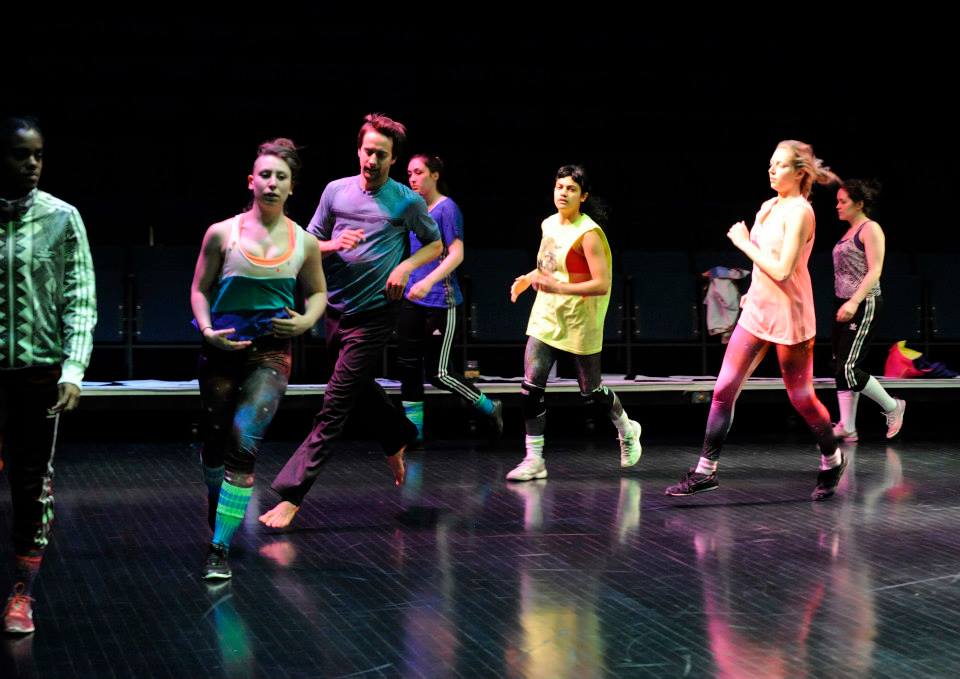
L'échauffement, photo by Nathalie St-Pierre
Une fois l’an, je produis une liste de fin d’année tout en me demandant ce que cela veut dire. Pourquoi ces artistes et non pas bon nombre d’autres? Cette fois, la réponse est simple; ce sont les artistes qui, pour une raison ou une autre, m’ont aidé à vivre. Cette année, je voulais aussi relayer cet exercice aux artistes en question. Je leur ai donc demandé « Quel artiste vous a aidé à vivre en 2015? » Voici leurs réponses.
​
Ève-Chems De Brouwer, metteur en scène, Docteur B. (Festival TransAmériques)
Picture
Docteur B., photo de Jean Weill
« Leon Bridges. Sa voix et ses paroles m'emplissent d'une joie douce et profonde. J'ai eu besoin d'écouter son album en boucle. Tiago Rodrigues. Son spectacle By Heart est d'une rare intelligence. C'est une ode à la lecture, aux mots. Mommy de Xavier Dolan va de toute évidence m'accompagner de longues années. J'ai eu une maman qui m'a aimée passionnément et inconditionnellement toute sa vie. Elle aurait volontiers donné ses deux bras et ses deux jambes pour nous. Retrouver cet amour maternel dans ce film époustouflant m'a transmis une force incroyable et une confiance pour ma vie de maman de deux jeunes enfants. Marcel Proust. Lire Proust me permet de me formuler à moi-même, d'avoir une acuité encore plus grande à l'Humain qui m'entoure. »
 
Nicolas Cantin, créateur, Philippines (OFFTA)
Picture
« J’ai beaucoup écouté Daft Punk en voyage cette année. Il y avait, par exemple, pour moi quelque chose de vertigineux à marcher seul dans les rues d’Honk Kong avec la musique de Daft Punk dans les oreilles. Et plus particulièrement le morceau Quo Veridis. Avec cette musique, ma solitude prenait une dimension métaphysique. Une véritable mise en orbite existentielle en 3D. Un voyage dans le voyage. »
​
Geneviève C. Ferron, chorégraphe, Tout est dit, il ne reste rien (Studio 303)
Picture
Tout est dit, il ne reste rien, photo de Sandra Lynn Bélanger
« En 2015 deux écrivaines m'ont aidé à vivre. L'œuvre d'Hélène Monette, que j'ai découverte à la suite de son décès en juin, et le recueil En Chair et en eau de la poétesse acadienne Judith Hamel. C'est avant tout leurs mots crus qui me touchent directement. Il n'y a pas de pudeur; c'est des grands sentiments qui ne se cachent pas derrière la forme ou la provocation. C'est aussi les femmes qui m'ont offert ces livres: Lili, la fille d'Hélène, ma demi-sœur, qui a voulu partager un peu de sa mère avec moi; et ma tante Michèle, qui m'a offert de la poésie acadienne pour me faire mieux comprendre ma mère, née en Acadie. »
​
Julien Fonfrède, programmateur, La Cinémathèque interdite
Picture
« L'expérience Valley of Love de Guillaume Nicloux. Un film qui épure tout. Un vrai tour de magie. Je ne comprends toujours pas comment il a réussi à faire que cela marche aussi bien. »
Every year, I put out some kind of year-end list, all the while wondering what it means. Why those artists and not countless others? This time around, the answer was simple; they’re the artists who, for one reason or another, have helped me live. This year, I also wanted to relay this exercise to the artists in question, so I asked them “Which artist made your life better in 2015?” Here are their answers.
​
Sasha Kleinplatz, choreographer, L’échauffement (Département de danse de l’UQAM)
“The facilitators and the participants of the Get B(l)ack research project at Impulstanz in Vienna, Austria. This project focused on Black Aesthetics and Contemporary Dance. We looked at Afro-Futurism, queer black dance, black feminist thought, the Black Lives Matter movement, and white privilege, among a ton of other things. There were many arguments, tears, and deeply awkward/alienating moments. What blew my mind is that everyone stayed and worked their asses off to find a way to talk and work together, no one gave up, and many people had every right to. The facilitators, Thomas D. Frantz and Keith Hennesey, were so firm, so clear and so gracious, refused to humour any white fragility, and at the same time they were extremely patient and remained determined to keep the group moving forward in thought and action. In a year where I felt a lot of confusion and disenchantment about the narrowness of the contemporary dance milieu (artistically, philosophically, and politically), I was so grateful to have this wakeup call that IT IS possible to work rigorously and ethically. And that there is a community of people doing it; we just have to keep finding each other.”
 
Mario Lombardi, organizer, The Atomic Cosmoline Electric Symphony Orchestra & Plasmatic Choir performs Terry Riley’s In C
“This past year was difficult for me; 1) as a human being dealing with mental illness, and 2) as an artist trying to fight against the creative oppression of my mental illness. The following artists have been important to me throughout 2015 not only as a form of relief, but more importantly for offering profound inspiration. In the fall, I rediscovered the brilliance of Magma. While introducing their album 1001° Centigrades to my friend in the midst of an exceptionally beautiful psilocybin trip, I had an epiphany! I felt as if I was discovering this masterful work all over again for the first time. The musical ideas were so inventive and creative. We both were so mind-blown that we ended up listening to the album repeatedly. I was fascinated by the unique and insanely creative singing of Klaus Blasquiz. In ‘contemporary classical’ music, I became entranced by Claude Vivier's work. For the first time, I felt I reached a profound understanding of his sonic expressions. These inspirations have heavily influenced my most recent compositional efforts for acoustic ensembles. Punk has had a huge presence in my life this year: artists like Flipper and No Trend; the gorgeously filth-obsessed, uncompromising work of Lydia Lunch; the deathrock pioneers Christian Death and Mighty Sphincter; the legendary Iggy Pop and the Stooges; hardcore bands Minor Threat and Bad Brains; anarcho-punk artists Crass and Flux of Pink Indians; the avant-garde punk experimentalists This Heat. Punk has always been at the foundation of my artistic mind ever since it took over my life as a teenager, but the fact that it has repossessed such a high place in my art diet might just be the most important and impactful thing to artistically happen to me this year. There is one more artist I'd like to bring praise to, an ensemble with whom I've been enamored for years; CAN have become one of my most cherished musical inspirations. Their sound, even 40+ years later, still manages to be incredibly fresh and insanely ahead of its time. Their mixture of extensive improvisation, acousmatic music elements and monotonous trance-like grooves; their exploration of noise, electronic soundscapes and unconventional sonic textures; the level of ingenuity in how they smash genre boundaries while sticking to a traditional rock ensemble instrumentation; the magnificent Damo Suzuki's exciting explorations of new expressive vocal possibilities (singing in improvised gibberish, electronically manipulating his voice, using unconventional sounds). CAN has enhanced my life this year more than any other artist and I have a feeling they'll keep doing so. There's still so much I feel I can learn from their art.”

LISTEN to the recording of the performance.
 
Jon Mueller, musician (Suoni Per Il Popolo)
Picture
“Over the past year I was struck numerous times by the work of photographer Niki Feijen, whose studies of abandoned places are like the graveyards of Gregory Crewdson photos. There's a sense of lost presence in his work, yet somehow a new presence, or the feeling that you, the viewer, are the only one present. There is a compulsion to look and to be within the photos, which has been an interesting experience to me. I think the bigger effect is that this work has inspired imagination within me in ways that were more familiar when I was really young – mystery, the unknown, and the idea of building something imaginary out of that in whatever way I wish.”
​
Anders Yates, writer & performer, Playday Mayday (Wildside Festival)
Picture
“The Pajama Men. I've been a fan of theirs for at least a decade and they've been a huge influence on Uncalled For's style, and this past March I was once again able to watch them perform together live for the first time in years and it was pure magic. They know how to play with each other in a way that is both disciplined and reckless and clearly fun. I got to enjoy the perfect mix of classic sketches I loved and new material I got to discover and a couple minutes of one just spanking the other. What more could I possibly want?”
0 Comments

De marfim e carne – as estátuas também sofrem: A Review

4/6/2015

0 Comments

 
Cabo Verdean choreographer Marlene Monteiro Freitas is back at Festival TransAmériques for the second year in a row, this time with De marfim e carne – as estátuas também sofrem. Last year, I was a fan of Paraíso, with its singular world created through the strict adherence of the dancers to their character-driven mode of performance and its potential for a feminist reading. Maybe it’s auteur theory’s fault, but now I’m wondering if maybe I was wrong last year…
Picture
De marfim a carne, photo by Pierre Planchenault
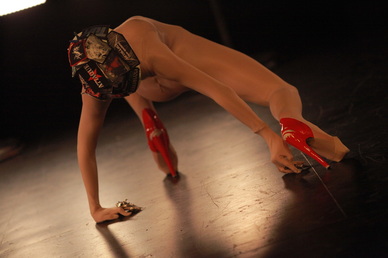
Here, the performers still create characters, but the world never follows suit. Instead, as can be seen in their insistence on facing the audience, they are merely performing for us. With the loud buzzer that periodically interrupts their performance, they appear like contestants on a reality TV show pathetically vying for our attention.

The show relies on excess (seven performers are onstage for the entire eighty minutes) but, rather than helping in making a particular environment emerge, this merely leads to distraction. Our eyes travel from one to another, noticing that some are merely moving not to be still during the main action and that the three cymbal players look the way I do when I hang out at a bar just hoping someone will take me home so I can get the fuck out of there. These musicians become a too easily accessible exit.

At the FTA back in 2008, I’d accused Marie Chouinard’s obnoxious Orphée et Eurydice of suffering from Middle Child Syndrome. I could say the same of De marfim e carne, which is funny because Freitas cites the myth of Orpheus as an inspiration in the program. Perhaps the artistically gifted Orpheus is ironically performance kryptonite. Maybe those who killed him could hear his so-called divine music after all.

During the show, I also thought about Nicolas Cantin. Last week, I saw his Philippines at the OFFTA. Cantin is definitely not for everyone, but artistically I admire his work, which seems perpetually concerned with figuring out what’s the least that one can do on a stage. I sometimes find myself wishing some shows, De marfim e carne being a perfect example, were doing less.

With its constant “let me entertain you” attitude, it sometimes seems like the show is striving to be a critique of the vacuity of entertainment culture. 1) Yes. 2) And…? 3) Where’s the critique? Because, with its lack of bite, De marfim e carne doesn’t seem to critique so much as to be complacent about the vapidity of entertainment. If anything, it capitalizes on it. It is the artistic equivalent of overconsumption.

Yet, when the dancers come back for an encore, i.e. the worst concert ritual, it seems like they must know they’re acting like the worst. In the words of Kurt Vonnegut, “We are what we pretend to be, so we must be careful about what we pretend to be.”

June 3 & 4 at 8pm
Place des Arts – Cinquième Salle
www.fta.qc.ca
514.844.3822
Tickets: 39$ / 30 years old and under: 33$
0 Comments

Paraíso – Colescção privada: A Review

5/6/2014

0 Comments

 
PictureParaíso – Colescção privada, photo by Hervé Véronèse
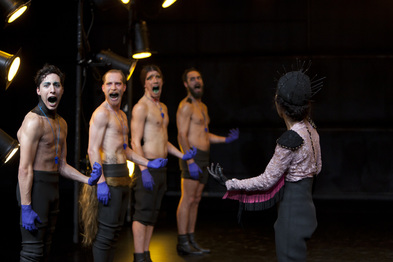
“Shake that ass” began my review of Ann Van den Broek’s Co(te)lette, and so could begin my review of Marlene Monteiro Freitas’s Paraíso – Colecção privada. Except there is a notable difference between the two works: in Co(te)lette, it was three women shaking their ass; in Paraíso, it’s three men.

Also, while the gaze of men could be felt everywhere in Co(te)lette, they were nowhere to be found onstage. In Paraíso, the opposite gender finds embodiment in Freitas herself, who appears as a gothic mistress of ceremony with organ music at her disposal. She wears a black cactus-like helmet that is potentially inspired by spiders and her top comes with matador-like shoulder pads.

For their part, the four men that join her are shirtless. Otherwise, some show the physical characteristics of particularly virile animals, like the tail of a horse or the horns of a ram. However, wild they are not. They are her beasts and they are most well trained, doing whatever she demands on command. Movements of her arms are scored by little bells, turning her creatures into Pavlov’s dogs.

While their shell is butch, their behaviour is otherwise. Their dance is spastic, nervous. They look like battery-operated toy dogs, their movement jerky, like they’ve been emptied out of their soul and are now more akin to robots. When in a particularly S&M section Freitas jams a harmonica in one man’s mouth, the other’s wide doe eyes reveal that each fears the same fate.

The horse-like man uses his hands to mimic wings on his back and a horn in the middle of his forehead, turning himself into a cross between a unicorn and a Pegasus. To satisfy their mistress’s desires, they must be able to change on a dime. There is something clown-like in the way all the performers act, if clowns weren’t the worst thing in the world.

One man moves his pecs to the music. She rewards her pets with food (peanuts?)… though not always. When they take a break, Freitas feasts on a chicken and even offers some to a few audience members, but none to her male dancers.

Her power extends beyond the stage as she orders the sound person to raise the volume or stop the music. She even targets coughing audience members by turning her hand into a fist.

Paraíso is a sexist fantasy turned on its head. The question is whose paradise, of course, since (as the subtitle implies) the concept is necessarily private, personal. It’s only ever paradise for who is in power.

The show might be a bit one-note, but it’s a pretty good fucking note. The movement vocabulary is singular and the dancers' commitment to it brings an equally unique world into being.

The four men leave the stage shortly before the end, leaving Freitas to hog the spotlight. I wish the choreographer had carried her premise to its ultimate end by being the only one to come back out to take a bow.

June 4-6 at 9pm
Agora de la danse
www.fta.qc.ca
514.844.3822 / 514.842.2112
Tickets: 38$ / 30 years old and under: 33$
0 Comments

(M)IMOSA : une critique

26/5/2012

0 Comments

 
Picture(M)IMOSA, photo de Paula Court
C’est bien d’avoir un groupe d’adolescentes dans un spectacle de danse. On peut souvent se fier à leurs réactions pour savoir si quelque chose d’intéressant se passe. Si elles se regardent constamment pour savoir comment elles devraient réagir (car on sait que, lorsqu’on est adolescent, les réactions individuelles sont interdites), c’est bon signe. C’est bien l’art qui laisse perplexe, face auquel même notre réaction ne peut être simpliste.

C’est ce qui s’est passé lors de la représentation de (M)IMOSA: Twenty Looks or Paris Is Burning at the Judson Church (M) en cette deuxième journée du Festival TransAmériques. Ce n’est peut-être pas surprenant étant donné que, comme le sous-titre l’indique, le chorégraphe new-yorkais Trajal Harrell croise la culture queer avec la vision démocratique du mouvement des chorégraphes postmodernes.

Et il n’est pas le seul chorégraphe-interprète. Il y en a trois de plus, rassemblant aussi Paris et Lisbonne : Cecilia Bengolea, François Chaignaud et Marlene Monteiro Freitas. On pourrait avoir peur que ce soit chaotique, et ce l’est, mais non pas à cause du nombre de chorégraphes, mais bien dû à l’esthétique postmoderne. Ironiquement, c’est aussi celle-ci qui permet au spectacle de faire preuve de cohésion.

Le courant postmoderne a donné de la fraicheur à la danse. (« Ça respire, » j’ai écrit dans mes notes.) Il y a quelque chose de libérateur lorsque les gens cessent de se soucier du beau, du sexy. Ça fait du bien être laid ou ridicule de temps en temps.

On retrouve dans (M)IMOSA le mouvement au quotidien, comme si les interprètes ne faisaient que danser dans leur chambre à coucher en chantant leur chanson du moment, sans trop se forcer, et que nous avions la chance de les espionner. D’un autre côté, il y a la performance « all eyes on me » des voguers et drag queens et kings. On peut d’abord se rappeler Spoken Word/Body de Martin Bélanger, et ensuite Pow Wow de Dany Desjardins, mais (M)IMOSA réussit mieux la transition au théâtre.

Peut-être que la relation avec le public en est la raison. Les lumières continuent d’éclairer les spectateurs durant la pièce, comme pour nous faire sentir qu’on fait partie intégrale du spectacle. On fait fi de la religiosité conventionnelle de la performance théâtrale, et c’est ce qui finit par théâtraliser le tout. Les interprètes se promènent parmi le public et cherchent leurs accessoires dans les rangées sans se soucier du bruit qu’ils font.

Il y a aussi quelque chose de rafraichissant à voir des interprètes de talent refuser la virtuosité, en faire moins qu’ils en sont clairement capables. Le talent se laisse alors deviner ici et là, et il n’en ait que plus réjouissant. En tout cas, leur confusion initiale passée, les adolescentes ont eu l’air de vraiment tripper.

(M)IMOSA
25-26 mai à 21h
Cinquième Salle
www.fta.qc.ca
514.844.3822 / 1.866.984.3822
Billets à partir de 35$
0 Comments

Still Standing You: a review

2/6/2011

0 Comments

 
PictureStill Standing You, photo by Phile Deprez
Have you ever wondered what Jackass would look like if it were contemporary dance instead of performance art? Me neither, yet last night I got to find out all the same. With Still Standing You, Belgian Pieter Ampe and Portuguese Guilherme Garrido have produced the kind of work that can only come from a place of deep friendship and trust. How else could a couple of straight buds hold each other’s sweaty cock?

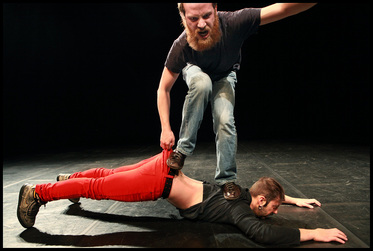
From the beginning, they are pushing their bodies to the limit as Ampe is lying on the floor, legs straight in the air, and Garrido sits on his feet while making casual conversation with the audience. As is often the case, the job is harder for Ampe, and Guilherme likes to be a dick about it. When he moves his feet to Ampe’s hands, he then puts his own hands on Ampe’s still erect feet, then his fists, then but a finger to show how easy his end of the deal is.

They grunt like cave men as they lift and rock each other as though fucking… before the one standing up forcefully throws the other on the ground. Riding on each other’s back, they act like Godzilla destroying the helpless tiny city below them. But play, just like sex, can on a dime turn brutal. Ampe stands on Garrido’s lying body and walks on top of him by lifting him by the belt and shirt.

There is no music (except for the percussive one they create with their bodies) and all the stage lights are on for the length of the show. While for most shows it is better to hide as much as possible to stimulate the imagination, here everything must be seen. Still Standing You is not trying to be pretty or graceful. When a move threatens to become so, the men simply drop each other on the ground. It’s about making it look hard rather than easy.

Still Standing You is a mix of physical feats (how to move around one another while holding each other’s penis?), slapstick, competitive play, juvenile behaviour, male bonding, circus acts, and sadomasochism. Both performers and audience members participate in the latter.

However, moments of genuine care can also be witnessed, like when one massages the ass of his partner… before pushing him down the floor with his feet. After all, S&M isn’t about hurting the other with malignant intent; it’s about caring enough about the other to be able to fulfil their desire to experience pain. The men also rest on top of each other, gently blow on each other, carry each other in their arms, and arrange each other’s pubic hair. It’s the kind of love that makes it possible to hit each other with a belt and still be okay with one another.

After the show, I heard someone say “C’est con, mais c’est bon.” Yes, it is bon. More than bon, actually. But con it certainly isn’t. If anything, Still Standing You is one of the densest shows I have ever seen. Someone could write a PhD thesis about it (and undoubtedly will). It’s about man with a small “m” as beast. It’s about the non-existent line between male bonding behaviour and homoeroticism. It takes the piss out of contemporary dance. It’s a parody of gender performance, of machismo. It’s camp. Who else can claim to have managed to perform drag while completely naked? It’s quite simply the most riveting show I’ve seen in years.

Still Standing You
June 1-3 at 9pm
Théâtre La Chapelle
www.fta.qc.ca
514.844.3822
Tickets: 28$ / Under 31, over 64 years old: 22$

0 Comments

    Sylvain Verstricht

    has an MA in Film Studies and works in contemporary dance. His creative writing has appeared in Headlight Anthology, Cactus Heart, Birkensnake, the mai/son Zine, and The Page.

    s.verstricht [at] gmail [dot] com

    Categories

    All
    2e Porte à Gauche
    Agora De La Danse
    Ame Henderson
    Andrew Tay
    Anne Le Beau
    Anne Teresa De Keersmaeker
    Anne Thériault
    Annie Gagnon
    Ann Van Den Broek
    Antoine Defoort
    Arthur Harel
    Arts Court
    Audrée Juteau
    Aurelie Pedron
    Austria
    Bain Saint-michel
    Belgium
    Benoit Lachambre
    Best Of
    Biennale De Gigue Contemporaine
    Bjm Danse
    Björn Schmelzer
    Boris Charmatz
    Brazil
    Brian Brooks
    Brigitte Haentjens
    Brigitte Poupart
    British Columbia
    Brooklyn Touring Outfit
    Cabaret Du Mile-End
    Caroline Gravel
    Carol Prieur
    Carte Blanche
    Cas Public
    Catalonia
    Catherine Gaudet
    Catherine Tardif
    Cayetano Soto
    Cecilia Bengolea
    Céline Bonnier
    Celine Signoret
    Centaur Theatre
    Chanti Wadge
    Chiara Frigo
    China
    Chris Haring
    Christian Rizzo
    Cindy Van Acker
    Cinema
    Clara Furey
    Compagnie Flak
    Conservatoire
    Dana Gingras
    Dana Michel
    Dance
    Daniel Léveillé
    Danse Carpe Diem
    Danse Cité
    Danse Danse
    Dany Desjardins
    Dave St Pierre
    David Lynch
    David Rancourt
    Deborah Dunn
    Dena Davida
    Dinozord/Patrick Mbungu
    Dorian Nuskind Oder
    Ecole De Danse Contemporaine
    Elisabeth Kjeldahl Nilsson
    Emmanuel Jouthe
    England
    English
    Erin Flynn
    Estelle Clareton
    Étienne Lepage
    Evelina Dembacke
    Evenko
    Festival TransAmériques
    Finland
    Francais
    France
    Francis Ducharme
    François Chaignaud
    Frederick Gravel
    Fringe
    Gabrielle Marion Rivard
    Galerie De L'UQAM
    Geneviève C. Ferron
    George Stamos
    Gerard Reyes
    Germany
    Grand Poney
    Guilherme Botelho
    Guilherme Garrido
    Guilherme Miotto
    Halory Goerger
    Heine Avdal
    Hélène Blackburn
    Hiroaki Umeda
    Holly Bright
    In Jung-ju
    Institutet
    Interviews
    Isabelle Van Grimde
    Italy
    Jacinthe Armstrong
    Jaco Van Dormael
    Jacques Poulin Denis
    James Viveiros
    Jamie Wright
    Jana Jevtovic
    Japan
    Jasper Van Lujik
    Jean Sébastien Lourdais
    Jody Hegel
    Jo Fong
    Jonathan Debrouwer
    José Navas
    Julien Desplantez
    Kaori Seki
    Karine Denault
    Katia Marie Germain
    Katie Ward
    Katya Montaignac
    Korea
    Kristel Van Issum
    (LA)HORDE
    La Sala Rossa
    Laurie Anderson
    Leanne Dyer
    Lee Su Jung
    Lemi Ponifasio
    Lia Rodrigues
    Lise Vachon
    Literature
    Louise Lecavalier
    Lucie Bazzo
    Lucie Mongrain
    Lük Fleury
    Maguy Marin
    Maïgwenn Desbois
    MAI (Montréal Arts Interculturels)
    Maki Morishita
    Manuel Roque
    Marc Boivin
    Margie Gillis
    Maria Kefirova
    Marie Béland
    Marie Brassard
    Marie Chouinard
    Marie Hélène Falcon
    Marilyne St Sauveur
    Marine Brutti
    Markus öhrn
    Marlene Monteiro Freitas
    Marteen Van Der Put
    Martin Messier
    Maryse Damecour
    Mary St-Amand Williamson
    Matija Ferlin
    Mau
    Mauro Bigonzetti
    Meg Stuart
    Mélanie Demers
    Michael Trent
    Michèle Anne De Mey
    Michèle Febvre
    Miguel Gutierrez
    Montréal Danse
    Montréal Nouvelles Musiques
    Monument National
    Music
    Nancy Gloutnez
    Natalie Zoey-gauld
    Netherlands
    New Zealand
    Nicolas Cantin
    Norway
    Nova Scotia
    Nya Rampen
    Offta
    Oh! My Life Movement Theater
    Olivier Arseneault
    Olivier Dubois
    Ontario
    Pamela Poulin
    Park Young-cool
    Patrick Lloyd Brennan
    Pauline Roelants
    Performance Art
    Perrine Valli
    Peter Trosztmer
    Philippe Meunier
    Pierre Lecours
    Pieter Ampe
    Piss In The Pool
    Place Des Arts
    Portugal
    Previews
    Quebec
    Rachel Harris
    Rachid Ouramdane
    Rebecca Halls
    Reviews
    Robyn Orlin
    Sarah Bronsard
    Sarah Chase
    Sarah Dell
    Sarah Williams
    Sasha Kleinplatz
    Shannon Gillen
    Simon Grenier Poirier
    Société Des Arts Technologiques
    South Africa
    Spain
    Spoken Word
    Stéphane Guignard
    Studio 303
    Susanna Hood
    Sweden
    Switzerland
    Tamara Bacci
    Tangente
    Tao Ye
    Teilo Troncy
    Teita Iwabuchi
    The 605 Collective
    Thea Patterson
    Theatre
    Theatre Jean-Duceppe
    Theatre La Chapelle
    The Choreographers
    Thirst/Clarity
    Trajal Harrell
    T.r.a.s.h.
    Ula Sickle
    United States
    Usine C
    Videos
    Virginie Brunelle
    Visual Arts
    Wales
    Wants&needs Danse
    Wayne Mcgregor
    Wildside Festival
    Yukiko Shinozaki
    Zohar Melinek

    RSS Feed

Powered by Create your own unique website with customizable templates.