|
Another year is coming to an end and once again I find myself looking back to see what is still visible in the mass of dance I’ve taken in this past year. Out of this pile of now mostly undistinguishable shows, the letter A stands out, blood red. While my love for contemporary dance stems from the unexpected that fuels the best shows, Tammy Forsythe’s Golpe showed me the limits of the medium by stepping well outside of them. As even one of its many detractors admitted, “J'ignorais […] qu'on pouvait être punk en danse contemporaine.” (Pablo Maneyrol) Sporting a DIY aesthetic, Golpe was raw, messy, and rough. It made me want to beat up anesthetically polished dance shows until blood started coming out of their pores, a most welcome sign of life dripping onto their bourgeois-wannabe clothes. Any so-called improvement that Golpe could have undergone would only have made it more generic. I would call it the most memorable show of the year if the French word “marquant” weren’t better, its “K” sound like a knife that cuts through the skin to leave a permanent scar. It’s thanks to Golpe that I can now entertain the hope that I might one day see a metal dance show. At the other end of the spectrum, there’s La Marche Invisible. While the definition of art is ever elusive, one still feels the certainty of being in the presence of a work that is deserving of the word at its most qualitative when watching Annie Gagnon’s creation. It was a perfect blend of dance, sculpture, music, lighting, and performance art. It showed the choreographer’s maturity as an artist. This past year, I was also fortunate enough to be in New York City when legendary post-modern choreographer Trisha Brown was celebrating the 40th anniversary of her company. For the occasion, I got to see Opal Loop/Cloud Installation #72503 (a work first performed in 1980) in the intimate space of the Baryshnikov Arts Center. When the curtains opened, a cloud of smoke rushed forward and made its way through the audience. Amidst these “clouds”, four dancers emerged, independently operating in silence for fifteen minutes. So when two of them suddenly jumped against one another at the exact same moment, it had the effect of an earthquake. Like what everything is a matter of contrast. Once again this year, Tangente (who was also behind La Marche Invisible) asserted itself as the venue for contemporary dance, programming daring work that many bigger spaces would never touch. Nowhere was this more apparent than with their Idea-Based Dances program, a three-week event where conceptual works were allowed to shine. Ula Sickle’s Solid Gold especially stands out. Dancer Patrick Mbungu (aka Dinozord) single-handedly covered the entire spectrum of dance from the African diaspora, from its roots in the motherland to recent street styles coming out of Los Angeles. All this in a mere thirty minutes, with his breath and footsteps as his only soundtrack. The most impressive performance of the year. Tawny Andersen's Uncanny Valley Part of the same program, Tawny Andersen played with the intensity of her performance in Uncanny Valley. Armed with a deadpan sense of humour, she demonstrated that, to be compelling, one needn’t necessarily fall into excess. At Agora de la danse, Michael Trent also surprised us with a highly conceptual work, It’s about time: 60 dances in 60 minutes. Five dancers repeated the same sequence of fifteen actions four times, each action first taking a minute, then fifteen seconds, three minutes, and a minute again. The experiment turned out to be a fascinating exploration of duration and its effects on both performers and audience members. For their part, UQAM students proved once more that daring work does not only belong to the most seasoned choreographers. With her graduating work Chorus, Raphaëlle Perreault put on a show that unfolded like a great piece of minimalist music. Only after each movement had been repeated numerous times was the next movement allowed to come in, so that the choreography slowly but surely took us to a different place than where it had started. Her schoolmate Sarah Dell’ava showed how deeply committed she is to seeing her ideas through to the very end. With her first professional work Dans les carnets, she proceeded to unfurl a large roll of paper over the ten minutes the piece lasted. The mystery that clouded her process made the performance captivating. A work that speaks to the spirit with which this selection is gathered is Michaël Cros’s Le Zoo “Chaleurhumaine”. While I greatly appreciated it when I saw it back in January, I did not expect it to find its way on this list. However, almost a year later, I am forced to admit that I am still haunted by its strangeness. In what is doubtlessly the best ambulatory dance piece of the last couple of years, audience members walked through a human zoo where two performers interacted with dummies entirely covered in black lycra. Disturbing images of racism, incest and violence raised important questions about the nature of the modern zoo in this highly experiential work. Last, but certainly not least, is Merce Cunningham’s Nearly 90. The late master’s ultimate work demonstrated why he is one of the most influential choreographers of the last century, his style so pure as to be monumental and timeless.
0 Comments
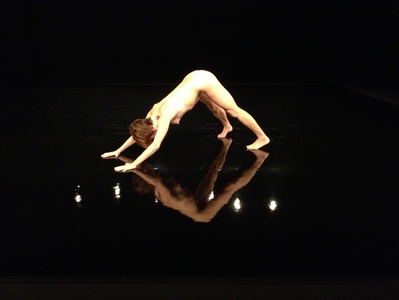
Introduction à l'introduction, photo de Maria de la Camara Un corps. Un corps nu. Le corps d’une femme, nu. Le corps de Sofia Asencio. Le plancher, noir, reflète l’image de la danseuse. Ne parlons pas d’un double. Parlons plutôt de la faculté unique que l’être humain possède de pouvoir se reconnaître. Parlons du moi. Assise, les jambes entrouvertes comme deux arcs, elle fait tourner son corps. Il est exposé. Il roule jusqu’à ce qu’elle sorte du plancher, qu’elle se heurte à la première rangée de spectateurs, des trois côtés de la scène. Reconnaître l’autre. Le corps nu est vu. La conscience. La danse est une forme d’exploration, lente et délibérée. Chaque mouvement est isolé; chaque position, aussi. Dans cette immobilité transitoire, le corps s’inscrit dans l’histoire de l’art. On pourrait y voir un sujet de peinture; la vulnérabilité du nu, exposée. Tout ceci se déroule dans le silence. Notre corps est plus bruyant que le sien. On s’entend respirer. On s’entend avaler. On s’entend bouger. Son corps nu est vu. La conscience. Asencio s’assoit sur un banc, toujours nue, et nous offre un mini-cours sur la métaphysique d’Aristote. Malheureusement, sa parole est moins délibérée que son mouvement. Elle trébuche sur les mots, les répète pour tenter une correction. La ponctuation semble répandue de façon arbitraire. Difficile de comprendre. Elle quitte la scène pour nous laisser observer un foulard accroché à un ventilateur danser sur la musique de Nina Simone. (Les chorégraphes ont vraiment une obsession avec cette chanteuse.) De par sa simplicité, Introduction à l’introduction est le genre de spectacle qui devrait naturellement me plaire. Toutefois, il y a une lacune qui empêche l’œuvre de s’imposer. Peut-être que le solo sur plancher-miroir nous rappelle Lanx de Cindy Van Acker, qui était beaucoup plus dense. Peut-être que le mini-cours devrait précéder la danse, comme l’avait fait Jody Hegel et Jana Jevtovic avec The Parcel Project, performance toute aussi simple, mais beaucoup plus rafraichissante. Close, but no cigar. 6-8 novembre à 20h Agora de la danse www.agoradanse.com 514.525.1500 Billets : 28$ / Étudiants ou 30 ans et moins : 20$ |
Sylvain Verstricht
has an MA in Film Studies and works in contemporary dance. His creative writing has appeared in Headlight Anthology, Cactus Heart, Birkensnake, the mai/son Zine, and The Page. s.verstricht [at] gmail [dot] com Categories
All
|


RSS Feed