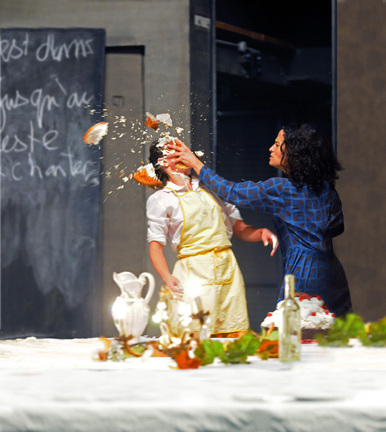
 Salves, photo by Jean-Pierre Maurin Salves, photo by Jean-Pierre Maurin Salves, Maguy Marin (Danse Danse) Septembre 26-28
Because last time Marin was in town, it was back in 2007 with Umwelt, which still holds as one of the best shows performed in Montreal this past decade. Prismes, Benoît Lachambre (L’Agora de la danse) October 16-19 Because Lachambre made quite the comeback last year with Snakeskins, his best show in years. Henri Michaux: Mouvements + Gymnopédies, Marie Chouinard (Danse Danse) October 31-November 2 Because Chouinard’s last show, LE NOMBRE D’OR (LIVE), is the one that has had the biggest impact on me since performer Carole Prieur first translated Henri Michaux’s drawings into dance back in 2005. We can only imagine what it will be like when all the dancers of the company will follow in her footsteps. Cuire Le Pain De Nos Corps, Sarah Dell’ava (Tangente) November 21-24 Because Dell’ava is probably the most intelligent mover in Montreal. LA VALEUR DES CHOSES, Jacques Poulin-Denis (Lachapelle) January 21-25 Because Poulin-Denis manages to expose the absurdity of human life while remaining funny and touching. The Nutcracker, Maria Kefirova (Tangente) January 30-February 2 Because Kefirova is one of the few choreographers in Montreal who knows how to deal with video in live performance. The adaptation project, Michael Trent (L’Agora de la danse) February 12-14 Because the last time Trent was in Montreal, he surprised everyone by being as conceptual as he was playful. Reviens Vers Moi Le Ventre En Premier, Annie Gagnon (Tangente) February 27-March 2 Because she’s one of the few choreographers in Montreal who’s not afraid to be serious. Mayday remix, Mélanie Demers (Usine C) March 12-14 Because, with just a few works, Demers has managed to establish herself as one of the most consistently good dancemakers in Montreal and it will be a treat to see her revisit her past works before moving on to the next artistic stage in her career. Mange-Moi, Andréane Leclerc (Tangente) March 20-23 Because Leclerc’s contortionism isn’t just a circus trick; it’s a philosophy that allows her to approach and explore space differently. http://dansedanse.ca/DDA_1314/en/ http://www.agoradanse.com/en http://tangente.qc.ca/ http://lachapelle.org/ http://www.usine-c.com/
1 Comment
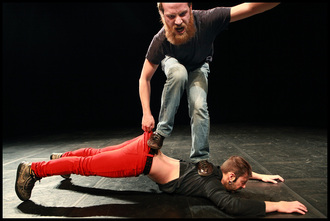 Still Standing You, photo de Phile Deprez Still Standing You, photo de Phile Deprez 2011 tire à sa fin. Heure des bilans. Retour sur les œuvres et artistes qui ont marqué le paysage de la danse à Montréal.
Encore une fois cette année, le Festival TransAmériques s’est démarqué grâce à la programmation audacieuse de Marie-Hélène Falcon. C’est ici qu’on aura trouvé le show de l’année, Still Standing You de Pieter Ampe et Guilherme Garrido, une pièce sans musique, sans éclairage théâtral, et éventuellement sans costume, où on ne peut que créditer la performance des deux chorégraphes-interprètes pour avoir créer un show des plus prenants. Derrière une grosse couche trash à la Jackass, ils ont composé le spectacle le plus dense de l’année. De son côté, la chorégraphe Cindy Van Acker a présenté non pas une, deux, ou trois pièces, mais bien quatre qui démontraient toutes un engagement total dans la poursuite d’idées chorégraphiques claires et simples, mais riches : Lanx, Obvie, Nixe, et Obtus. À partir de séquences de mouvements souvent élémentaires, elle composait une danse si pure qu’elle en devenait graphisme et parfois même voyage initiatique parmi un éclairage sculptural de néons. Du côté du Québec, la chorégraphe Chanti Wadge a quant à elle créer un univers magique aux côtés du magnifique danseur David Rancourt avec o deer! Inspirée par les rituels autochtones et le règne animal, elle a réussi à invoquer les esprits ancestraux et transformer les corps, occasionnant l’émergence de la nature en plein milieu de la ville. Aussi digne d’être mentionné : Bodies in Urban Spaces de Willi Dorner, pour laquelle une douzaine de jeunes danseurs se sont adonnés à un mélange de parkour et de planking pour s’insinuer dans des racoins du centre-ville qui auraient autrement paru hors de notre portée. La masse spectatrice déambulatoire devenait elle-même un objet de spectacle pour les passants qui n’avaient aucune idée de ce qui se passait. On avait le sourire collé au visage et on regarde encore la ville d’un autre œil. Pour clore cette longue parenthèse FTA, finissons avec la chorégraphe Lia Rodrigues qui a trouvé son inspiration dans le chaos pour Pororoca. De la parade initiale des multiples interprètes qui fait du plancher un dégât jusqu’à leur installation en une ligne verticale en milieu de scène où ils exécuteront la majorité de leur danse dans cette formation hors du commun, le désordre permet aux danseurs de repenser le mouvement et de se rencontrer dans un corps-à-corps qui peut être autant empreint de violence que d’amour. Côté diffuseur, c’est toujours Tangente qui mène la danse contemporaine de l’avant avec une programmation éclectique et ouverte à l’innovation. On retient surtout deux pièces. La première : Costing not less than everything de Susanna Hood. Dans ce solo interprété de façon magistrale par Holly Bright, la lumière qui frappe le corps vulnérable de la danseuse est celle qui illumine aussi son chemin, au bout duquel elle dira oui à tout ce qui s’offre à elle, puisque tout passe par la vie. Profondément touchant. Deuxième coup de cœur chez Tangente : Tokyo Loft (Koshitsu) de Maki Morishita. Pour cette pièce, la chorégraphe-interprète a limité sa danse à un carré grand comme un ascenseur pour aborder de façon ludique la place réservée à l’art dans nos vies occupées et la nécessité de l’imagination pour surmonter une certaine passivité intellectuelle et physique moderne. C’était aussi drôle qu’inquiétant. À l’Agora de la danse, c’est Ame Henderson qui a une fois de plus fasciné avec sa pièce de groupe relay. La chorégraphe a équipé ses interprètes d’une structure précise qui leur permettait de danser en synchro n’importe quelles séries de mouvements qu’ils avaient apprises au cours de leurs carrières de danseurs; donc chaque représentation était complètement différente. Quand on pense que l’an dernier c’était Michael Trent qui nous avait surpris avec It’s about time, c’est à se demander si c’est maintenant à Toronto que la danse conceptuelle se fait. À Montréal, Sarah Dell’Ava est à peu près la seule à porter ce flambeau. Avec Esquisse 3 : Dans les plis, elle a une fois de plus prouvé qu’elle demeure la chorégraphe émergente à surveiller. Elle démontre l’intérêt qu’il y a à danser avec sa tête et non pas juste avec son corps. Elle remontera Dans les plis pour Tangente au Monument-National du 9 au 12 février. C’est évidemment à ne pas manquer. Un autre chorégraphe émergent qui mérite qu’on parle de lui : Patrick Lloyd Brennan, qui n’a pas attendu après les diffuseurs pour montrer son travail; il a présenté sa nouvelle création dans son propre loft. The New Bourjoiesie était un portrait satirique décapant d’une génération éduquée, nourrie de références culturelles, mais autrement incapable d’accomplir quoi que ce soit. L’art comme miroir déstabilisant. 2011, c’était aussi évidemment l’année de Marie Chouinard, qui fêtait les vingt ans de sa compagnie avec une longue série de spectacles. On se remémore Étude No 1, solo reposant presque entièrement sur les… pieds de Lucie Mongrain, qui dansait la claquette sur un plancher bourré de micros. Chouinard a un don pour la dramatisation de l’espace et c’était ici à son apogée. Avec son nouveau spectacle, LE NOMBRE D’OR (LIVE), elle a créé un monde étrange peuplé de créatures qui (du moins au début) ne semblaient rien avoir en commun avec nous. Une réflexion originale sur l’altérité de l’humain. Il faudrait aussi noter que plus de la moitié des pièces mentionnées ici (celles de Cindy Van Acker, Susanna Hood, Maki Morishita, Sarah Dell’Ava, et une de Marie Chouinard) sont des soli. Je ne suis pas sûr quelle conclusion en tirer… Peut-être qu’à défaut de quantité elles osent nous offrir la qualité? Habituellement, je ne mentionne pas de mauvais coups parce qu’on s’entend que, contrairement au cinéma ou à la musique, il est difficile d’argumenter que les artisans de la danse essaient de nous faire avaler de la merde pour faire des profits. Toutefois, cette année, je dois avouer être d’accord avec Fabienne Cabado du Voir et Aline Apostolska et Stéphanie Brody de La Presse; je commence moi aussi à être un peu tanné de la programmation du Théâtre La Chapelle, qui semble de plus en plus déterminée par leur marketing. Ils capitalisent un peu trop sur l’excitation des organes génitaux et pas assez sur celle de l’esprit. En espérant que ça change en 2012… Sur ce, Bonne et heureuse année! |
Sylvain Verstricht
has an MA in Film Studies and works in contemporary dance. His fiction has appeared in Headlight Anthology, Cactus Heart, and Birkensnake. s.verstricht [at] gmail [dot] com Categories
All
|
 RSS Feed